


Influence of Innovative Processing on γ‐Aminobutyric Acid (GABA) Contents, Phytochemicals, and Antioxidant Activity in Flavoured Germinated Rice Powder Products
Article Sidebar
Views | PDF/EPUB Downloads:
231
/ 118
/ 86
Main Article Content
Abstract
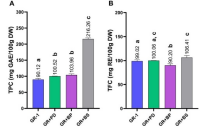
Germinated rice (GR) is rich in dietary fibre and bioactive compounds, such as GABA and polyphenol compounds, and exhibits antioxidant activity. The objective of this study was to evaluate the levels of GABA, total phenolics, total flavonoids, free phenolics, and free flavonoids, as well as antioxidant activities in germinated rice powder with different flavours. GABA content was determined using LC-MS/MS, antioxidant activities were assessed using DPPH and FRAP assays, and the quantification of free polyphenols was performed using HPLC. The flavoured germinated rice powder products were mixtures of five rice cultivars, combined with four flavours: original, pandan leaves, butterfly pea flowers, and black sesame seed. The results showed that GR with black sesame seed exhibited the highest antioxidant activity (DPPH radical scavenging: 205.21 mg TE/100 g DW; FRAP value: 983.20 mM FeSO4/100 g DW). The highest GABA content was found in the original GR (95.54 ± 1.36 µg/100 g), followed by GR with black sesame seed, GR with pandan, and GR with butterfly pea, respectively. The presence of p-coumaric acid, rutin, quercetin, myricetin, and kaempferol was detected in all four flavoured GR samples. Based on the high antioxidant activities and total phenolic and flavonoid content, GR with black sesame seed received the most favourable evaluation. Overall, germinated rice combined with herbal additives, due to its high GABA, phenolic, and flavonoid contents and strong antioxidant activity, holds great potential for the development of functional or health-promoting food products.
Downloads
Article Details
Section

This work is licensed under a Creative Commons Attribution-NonCommercial-NoDerivatives 4.0 International License.
How to Cite
References
1. Cáceres PJ, Martínez-Villaluenga C, Amigo L, Frias J. Assessment on proximate composition, dietary fiber, phytic acid and protein hydrolysis of germinated Ecuatorian brown rice. Plant Foods Hum. Nutr. 2014; 69: 261-267. Doi:10.1007/s11130-014-0433-x DOI: https://doi.org/10.1007/s11130-014-0433-x
2. Cho DH, Lim ST. Germinated brown rice and its bio-functional compounds. Food Chem. 2016;196: 259-271. Doi: 10.1016/j.foodchem.2015.09.025 DOI: https://doi.org/10.1016/j.foodchem.2015.09.025
3. do Nascimento LÁ, Abhilasha A, Singh J, Elias MC, Colussi R. Rice germination and its impact on technological and nutritional properties: A review. Rice Sci. 2022; 9(3): 201-215. Doi: 10.1016/j.rsci.2022.01.009 DOI: https://doi.org/10.1016/j.rsci.2022.01.009
4. Thitinunsomboon S, Keeratipibul S, Boonsiriwit A. Enhancing gamma-aminobutyric acid content in germinated brown rice by repeated treatment of soaking and incubation. Food Sci. Technol. Int. 2013; 19(1): 25-33. Doi: 10.1177/1082013212442 DOI: https://doi.org/10.1177/1082013212442180
5. Wu F, Yang N, Touré A, Jin Z, Xu X. Germinated brown rice and its role in human health. Crit. Rev. Food Sci. Nutr. 2013; 53(5): 451-463. Doi: 10.1080/10408398.2010.542259 DOI: https://doi.org/10.1080/10408398.2010.542259
6. Cornejo F, Caceres P J, Martínez-Villaluenga C, Rosell CM, Frias J. Effects of germination on the nutritive value and bioactive compounds of brown rice breads. Food Chem. 2015; 173: 298-304. Doi: 10.1016/j.foodchem.2014.10.037 DOI: https://doi.org/10.1016/j.foodchem.2014.10.037
7. Zhao M, Lin Y, Chen H. Improving nutritional quality of rice for human health. Theor. Appl. Genet. 2020; 133: 1397-1413. Doi: 10.1007/s00122-019-03530-x DOI: https://doi.org/10.1007/s00122-019-03530-x
8. Lee JS, Sreenivasulu N, Hamilton RS, Kohli A. Brown rice, a diet rich in health promoting properties. J. Nutr. Sci. Vitaminol. 2019; 65(Supplement): S26-S28. Doi: 10.3177/jnsv.65.S26 DOI: https://doi.org/10.3177/jnsv.65.S26
9. Nielsen SS. Determination of Moisture Content. In: Nielsen SS. (eds) Food Analysis Laboratory Manual. Food Science Texts Series. Boston: Springer; 2010. 17-27 p. DOI: https://doi.org/10.1007/978-1-4419-1463-7_3
10. El-Naggar T, Carretero ME, Arce C, Gómez-Serranillos MP. Methanol extract of Nigella sativa seed induces changes in the levels of neurotransmitter amino acids in male rat brain regions. Pharm. Biol. 2017; 55(1): 1415-1422. Doi: 10.1080/13880209.2017.1302485 DOI: https://doi.org/10.1080/13880209.2017.1302485
11. Eckstein JA, Ammerman GM, Reveles JM, Ackermann BL. Analysis of glutamine, glutamate, pyroglutamate, and GABA in cerebrospinal fluid using ion pairing HPLC with positive electrospray LC/MS/MS. J. Neurosci. Methods 2008; 171(2): 190-196. Doi: 10.1016/j.jneumeth.2008.02.019 DOI: https://doi.org/10.1016/j.jneumeth.2008.02.019
12. Jannoey P, Niamsup H, Lumyong S, Tajima S, Nomura M, Chairote G. γ-aminobutyric acid (GABA) accumulations in rice during germination. Chiang Mai J. Sci. 2010; 37(1): 124-133.
13. Shen Y, Jin L, Xiao P, Lu Y, Bao J. Total phenolics, flavonoids, antioxidant capacity in rice grain and their relations to grain color, size and weight. J. Cereal Sci. 2009; 49(1): 106-111. Doi: 10.1016/j.jcs.2008.07.010 DOI: https://doi.org/10.1016/j.jcs.2008.07.010
14. Ghasemzadeh A, Karbalaii MT, Jaafar HZ, Rahmat A. Phytochemical constituents, antioxidant activity, and antiproliferative properties of black, red, and brown rice bran. Chem. Cent. J. 2018; 12(1): 1-13. Doi: 10.1186/s13065-018-0382-9 DOI: https://doi.org/10.1186/s13065-018-0382-9
15. Fernandes RDPP, Trindade MA, Tonin FG, Lima CGD, Pugine SMP, Munekata PES, Lorenzo JM, de Melo MP. Evaluation of antioxidant capacity of 13 plant extracts by three different methods: cluster analyses applied for selection of the natural extracts with higher antioxidant capacity to replace synthetic antioxidant in lamb burgers. J. Food Sci. Technol. 2016; 53: 451-460. Doi: 10.1007/s13197-015-1994-x DOI: https://doi.org/10.1007/s13197-015-1994-x
16. Department of Foreign Trade, Ministry of Commerce. Thailand Standards for Rice. Nonthaburi: Bureau of National Imports-Exports Products Standards; 2017. 117 p.
17. Chungcharoen T, Sansiribhanb S, Munsin R, Thuwapanichayanan R, Palamanit A, Sukkeaw P, Phetpan K. Influence of germinated brown rice production by water spraying method on its qualities. Curr. Appl. Sci. Technol. 2023; 23(3): 1-11. DOI: https://doi.org/10.55003/cast.2022.03.23.007
18. Wu N-N, Li R, Li Z-J, Tan B. Effect of germination in the form of paddy rice and brown rice on their phytic acid, GABA, γ-oryzanol, phenolics, flavonoids and antioxidant capacity. Food Res. Int. 2022; 159: 111603. Doi: 10.1016/j.foodres.2022.111603 DOI: https://doi.org/10.1016/j.foodres.2022.111603
19. Yamuangmorn S, Saenjum C, Prom-U-Thai C. Germination alters the bioactive compounds of pigmented and non-pigmented rice varieties in fresh and year-old stored seeds. Food Chem. X 2024; 24: 102005. Doi: 10.1016/j.fochx.2024.102005
20. Tiansawang K, Luangpituksa P, Varanyanond W, Hansawasdi C. GABA (γ-aminobutyric acid) production, antioxidant activity in some germinated dietary seeds and the effect of cooking on their GABA content. Food Sci. Technol. 2016; 36(2): 313-321. DOI: https://doi.org/10.1590/1678-457X.0080
21. Suwannatrai K, Namwongsa K, Phanomkhet N, Nuntapanich H, Roschat W. The analysis of nutritional value, total phenolic and flavonoid contents, and antioxidant activities from the ethanolic extracts of the roasted broken brown rice powder. SNRU J. Sci. Technol. 2022; 14(2): 246426-246426. Doi: 10.55674/snrujst.v14i2.246426 DOI: https://doi.org/10.55674/snrujst.v14i2.246426
22. Kammapana L. Physical characteristics, phytochemical contents and antioxidant activity of ten organic-pigmented rice varieties from Surin Province. Trends Sci. 2023; 20(4): 4566-4566. Doi:10.48048/tis.2023.4566 DOI: https://doi.org/10.48048/tis.2023.4566
23. Tyagi A, Shabbir U, Chen X, Chelliah R, Elahi F, Ham HJ, Oh DH. Phytochemical profiling and cellular antioxidant efficacy of different rice varieties in colorectal adenocarcinoma cells exposed to oxidative stress. PLoS ONE 2022; 17(6): e0269403. Doi: 10.1371/journal.pone.0269403 DOI: https://doi.org/10.1371/journal.pone.0269403
24. Nurhidajah N, Rosidi A, Yonata D, Pranata B. Optimizing extraction of functional compounds from Indonesian black rice using response surface methodology. Food Res. 2022; 6(4): 83-91. DOI: https://doi.org/10.26656/fr.2017.6(4).732
25. Ruslan K, Happyniar S, Fidrianny I. Antioxidant potential of two varieties of Sesamum indicum L. collected from Indonesia. J Taibah Univ Med Sci. 2018; 13(3): 211-218. DOI: https://doi.org/10.1016/j.jtumed.2018.02.004
26. Prathumtet J, Surasorn C, Paopa T. Total phenolic content and antioxidant activity of three flower infusion tea in Sakon Nakhon Province. J. Health Sci. Thailand 2019; 28(6): 1110–1115.
27. Quyen NTC, Quyen NTN, Nhan LTH, Toan TQ. Antioxidant activity, total phenolics and flavonoids contents of Pandanus amaryllifolius (Roxb.). IOP Conf. Ser.: Mater. Sci. Eng. 2020; 991(2020): 012019. Doi: 10.1088/1757-899X/991/1/012019
28. Butsat S, Siriamornpun S. Antioxidant capacities and phenolic compounds of the husk, bran and endosperm of Thai rice. Food Chem. 2010; 119(2): 606-613. DOI: https://doi.org/10.1016/j.foodchem.2009.07.001
29. Punnongwa W, Muangmala W, Boonsaduak P, Chaiwachirakhampon A, Wardkean, N. Effect of encapsulation of bioactive compounds from germinated black rice for rice cracker. Food Res. 2025; 9(1): 175 - 185. DOI: https://doi.org/10.26656/fr.2017.9(1).378
30. Pramai P, Thongsook T, Thanasukarn P, Jannoey P, Nuengchamnong N, Chen F, Maulidiani M, Abas F, Jiamyangyuen S. Chemical profiles of three varieties of germinated rice based on LC MS and their antioxidant activity. Food Appl. Biosci. J. 2019; 7(2): 11-32.
31. Yamuangmorn S, Saenjum C, Prom-U-Thai C. Germination alters the bioactive compounds of pigmented and non-pigmented rice varieties in fresh and year-old stored seeds. Food Chem. X 2024; 24: 102005. Doi: 10.1016/j.fochx.2024.102005 DOI: https://doi.org/10.1016/j.fochx.2024.102005
32. Multisona RR, Shirodkar S, Arnold M, Gramza-Michalowska A. Clitoria ternatea flower and its bioactive compounds: potential use as microencapsulated ingredient for functional foods. Appl. Sci. 2023; 13(4): 2134. https://doi.org/10.3390/app13042134 DOI: https://doi.org/10.3390/app13042134
33. Kumar MN, More DR. Phytochemical analysis and bioactivity of selected medicinal plant of butterfly-pea (Clitoria ternatea L.) used by Kolam tribe adjoining region of Telangana and Maharashtra states. Pharma Innov. J. 2019; 8(1): 417-421.
34. Kermani SG, Saeidi G, Sabzalian MR, Gianinetti A. Drought stress influenced sesamin and sesamolin content and polyphenolic components in sesame (Sesamum indicum L.) populations with contrasting seed coat colors. Food Chem. 2019; 289: 360-368. DOI: https://doi.org/10.1016/j.foodchem.2019.03.004
35. Nor FM, Mohamed S, Idris NA, Ismail R. Antioxidative properties of Pandanus amaryllifolius leaf extracts in accelerated oxidation and deep-frying studies. Food Chem. 2008; 110(2008): 319-327. DOI: https://doi.org/10.1016/j.foodchem.2008.02.004
36. Ghasemzadeh A, Jaafar HZ. Profiling of phenolic compounds and their antioxidant and anticancer activities in pandan (Pandanus amaryllifolius Roxb.) extracts from different locations of Malaysia. BMC Complement Altern Med. 2013; 13: 341. Doi: 10.1186/1472-6882-13-341 DOI: https://doi.org/10.1186/1472-6882-13-341
37. Nammatra R, Chaloemram C, Chanhan, P. Phytochemical contents and antioxidant activities of Thai herbal tea from leaves of Morus alba and Citrus hystrix. J. Sci. Agric. Technol. 2021; 2(1): 21-27.
38. Nammatra R, Srihawong T, Chaloemram C. Evaluation of phytochemical constituents and antioxidant activities of different formula of heart tonic herbal teas. J. Sustain. Sci. Manag. 2021; 16(2): 94-104. DOI: https://doi.org/10.46754/jssm.2021.02.010