


In Silico Evaluation of 3,6-Anhydro-D-Galactose from Eucheuma denticulatum Targeting Breast Cancer-Associated Molecular Pathways
Article Sidebar
Views | PDF/EPUB Downloads:
105
/ 60
/ 33
Main Article Content
Abstract
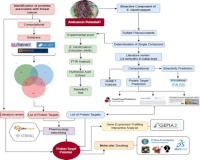
Breast cancer is a major global health concern, ranking among the leading causes of morbidity and mortality worldwide. Despite available therapies, drug resistance and side effects underscore the need for novel, safe, and effective treatments. Marine-derived bioactive compounds have attracted significant attention due to their diverse pharmacological properties, including anticancer activity. For example, 3,6-Anhydro-D-galactose (3,6-D-AHG), a monomer derived from the degradation of iota-carrageenan in the red macroalga Eucheuma denticulatum, has shown promising bioactivity. This study aimed to evaluate the anticancer potential of 3,6-D-AHG against breast cancer through a comprehensive in silico approach. Iota-carrageenan was extracted using microwave-assisted extraction, hydrolyzed to produce 3,6-D-AHG, and characterized by Fourier transform infrared (FTIR) spectroscopy. Computational analyses included ADMET profiling (AdmetLab 2.0), bioactivity prediction (PASS), protein target identification, network pharmacology analysis, gene expression profiling (GEPIA2), and molecular docking. FTIR spectroscopic data confirmed characteristic peaks of iota-carrageenan and 3,6-D-AHG at 1220-1260 cm⁻¹ and 848-930 cm⁻¹, respectively. ADMET showed favorable pharmacokinetics, low toxicity, and compliance with Lipinski’s rule, while PASS predicted a high probability of glucose oxidase inhibition. Key molecular targets identified were HK2, HSPA5, CA12, and LGALS3. Molecular docking showed a strong binding affinity of 3,6-D-AHG with HK2 and HSPA5 (–5.6 kcal/mol), exceeding that of D-glucose used as the control, suggesting disruption of cancer cell metabolism and stress response. In conclusion, 3,6-D-AHG is a promising candidate for breast cancer therapy. The results, although predictive, provide a strong rationale for further studies, supporting the potential of Indonesian marine resources as valuable sources of novel anticancer agents.
Downloads
Article Details
Section

This work is licensed under a Creative Commons Attribution-NonCommercial-NoDerivatives 4.0 International License.
How to Cite
References
1.Ferrari AJ, Santomauro DF, Aali A, Abate YH, Abbafati C, Abbastabar H, Abd ElHafeez S, Abdelmasseh M, Abd-Elsalam S, Abdollahi A, Abdullahi A, Abeldaño Zuñiga RA, Aboagye RG, Abolhassani H, Abreu LG, Abualruz H, Abu-Gharbieh E, Abu-Rmeileh NM, Murray CJL. Global Incidence, Prevalence, Years Lived with Disability (YLDs), Disability-Adjusted Life-Years (DALYs), and Healthy Life Expectancy (HALE) for 371 Diseases and Injuries in 204 Countries and Territories and 811 Subnational Locations, 1990–2021: A Systematic Analysis for the Global Burden of Disease Study 2021. Lancet. 2024; 403(10440):2133–2161.
2.Sung H, Ferlay J, Siegel RL, Laversanne M, Soerjomataram I, Jemal A, Bray F. Global Cancer Statistics 2020: GLOBOCAN Estimates of Incidence and Mortality Worldwide for 36 Cancers in 185 Countries. CA Cancer J Clin. 2021; 71(3):209–249.
3.International Agency for Research on Cancer (IARC). GLOBOCAN 2022: Indonesia – Fact Sheet: All Cancers [Internet]. World Health Organization; 2022 [cited 2025 Sep 15]. Available from: https://gco.iarc.fr/today/data/factsheets/populations/360-indonesia-fact-sheets.pdf.
4.Waks AG and Winer EP. Breast Cancer Treatment: A Review. JAMA. 2019; 321(3):288–300.
5.Necas J and Bartosikova L. Carrageenan: A Review. Vet Med (Praha). 2013; 58(4):187–205.
6.Bayu A, Warsito MF, Putra MY, Karnjanakom S, Guan G. Macroalgae-Derived Rare Sugars: Applications and Catalytic Synthesis. Carbon Resour Convers. 2021; 4:150–163.
7.Calvo GH, Cosenza VA, Sáenz DA, Navarro DA, Stortz CA, Céspedes MA, Mamone LA, Casas AG, Di Venosa GM. Disaccharides Obtained from Carrageenan as Potential Antitumor Agents. Sci Rep. 2019; 9:6654.
8.Yuan H, Song J, Li X, Li N, Dai J. Immunomodulation and Antitumor Activity of κ-Carrageenan Oligosaccharides. Pharmacol Res. 2006; 54(1):47–55.
9.Yustisia I, Hardjo M, Hasri, Sari WON, Kasmiati. Optimization and Characterization of Kappaphycus alvarezii and κ-Carrageenan Hydrolysates with Potential Biomedical Applications. Food Hydrocoll Health. 2025; 7:100205.
10.Panjaitan RS and Natalia L. Ekstraksi Polisakarida Sulfat Dari Sargassum polycystum Dengan Metode Microwave Assisted Extraction Dan Uji Toksisitasnya. JPB Kelautan Perikanan. 2021; 16(1):23–32.
11.Hernández-López A, Sánchez Félix DA, Zuñiga Sierra Z, García Bravo I, Dinkova TD, Avila-Alejandre AX. Quantification of Reducing Sugars Based on the Qualitative Technique of Benedict. ACS Omega. 2020; 5:32403–32410.
12.Kim S, Chen J, Cheng T, Gindulyte A, He J, He S, Li Q, Shoemaker BA, Thiessen PA, Yu B, Zaslavsky L, Zhang J, Bolton EE. PubChem in 2021: New Data Content and Improved Web Interfaces. Nucleic Acids Res. 2021; 49(D1):D1388–D1395.
13.Xiong G, Wu Z, Yi J, Fu L, Yang Z, Hsieh C, Yin M, Zeng X, Wu C, Lu A, Chen X, Hou T, Cao D. ADMETlab 2.0: An Integrated Online Platform for Accurate and Comprehensive Predictions of ADMET Properties. Nucleic Acids Res. 2021; 49(W1):W5–W14.
14.Filimonov DA, Lagunin AA, Gloriozova TA, Rudik AV, Druzhilovskii DS, Pogodin PV, Poroikov VV. Prediction of the Biological Activity Spectra of Organic Compounds Using the PASS Online Web Resource. Chem Heterocycl Compd. 2014; 50(3):444–457.
15.Ren X, Yan CX, Zhai RX, Xu K, Li H, Fu XJ. Comprehensive Survey of Target Prediction Web Servers for Traditional Chinese Medicine. Heliyon. 2023; 9:e19151.
16.Pati A, Gaur M, Sahu A, Subudhi BB, Kar D, Parida JR, Kuanar A. Drug Target Screening for Rheumatoid Arthritis by Curcuma caesia Through Computational Approach. Curr Plant Biol. 2025; 42:100468.
17.Hu M, Yan H, Li H, Feng Y, Sun W, Ren Y, Ma L, Zeng W, Huang F, Jiang Z, Dong H. Use of Network Pharmacology and Molecular Docking to Explore the Mechanism of Action of Curcuma in the Treatment of Osteosarcoma. Sci Rep. 2023; 13:9569.
18.Karima R, Elya B, Sauriasari R. Mechanism of Action of Glucomannan as a Potential Therapeutic Agent for Type 2 Diabetes Mellitus Based on Network Pharmacology and Molecular Docking Simulation. Trop J Nat Prod Res. 2023; 7(12):5460–5469.
19.Tang Z, Kang B, Li C, Chen T, Zhang Z. GEPIA2: An Enhanced Web Server for Large-Scale Expression Profiling and Interactive Analysis. Nucleic Acids Res. 2019; 47(W1):W556–W560.
20.Khotimah H, Hartiyo LB, Istiana S, Katili I, Jatmiko W. Prediction of Anti-Inflammatory Effects of Rosmarinus officinalis L. in Osteoarthritis Through Inhibition in PGE2-R, COX-2, and IL-1β: An In Silico Study. Trop J Nat Prod Res. 2025; 9(2):504–511.
21.Krylova NV, Kravchenko AO, Iunikhina OV, Pott AB, Likhatskaya GN, Volod'ko AV, Zaporozhets TS, Shchelkanov MY, Yermak IM. Influence of the Structural Features of Carrageenans From Red Algae of the Far Eastern Seas on Their Antiviral Properties. Mar Drugs. 2022; 20(1):60.
22.Usov AI. Polysaccharides of the Red Algae. Adv Carbohydr Chem Biochem. 2011; 65:115–217.
23.Liu J, Kandasamy S, Zhang J, Kirby CW, Karakach T, Hafting J, Critchley AT. Prebiotic Effects of Diet Supplemented with the Cultivated Red Seaweed Chondrus crispus or Its Isolated Polysaccharide Fraction in Rats. Front Microbiol. 2016; 7:826.
24.Cunha L and Grenha A. Sulfated Seaweed Polysaccharides as Multifunctional Materials in Drug Delivery Applications. Mar Drugs. 2016; 14(3):42.
25.Lipinski CA, Lombardo F, Dominy BW, Feeney PJ. Experimental and Computational Approaches to Estimate Solubility and Permeability in Drug Discovery and Development Settings. Adv Drug Deliv Rev. 2001; 46(1-3):3–26.
26.Tian X, Srinivasan PR, Tajiknia V, Sanchez Sevilla Uruchurtu AF, Seyhan AA, Carneiro BA, De La Cruz A, Pinho-Schwermann M, George A, Zhao S, Strandberg J, Di Cristofano F, Zhang S, Zhou L, Raufi AG, Navaraj A, Zhang Y, Verovkina N, Ghandali M, Ryspayeva D, El-Deiry WS. Targeting Apoptotic Pathways for Cancer Therapy. J Clin Invest. 2024; 134(14):e179570.
27.Levine AJ. p53: 800 Million Years of Evolution and 40 Years of Discovery. Nat Rev Cancer. 2020; 20:471–480.
28.Rawlings ND and Salvesen GS. Handbook of Proteolytic Enzymes. Academic Press; 2013.
29.Kushkevych I, Dordević D, Alberfkani MI, Gajdács M, Ostorházi E, Vítězová M, Rittmann SKMR. NADH and NADPH Peroxidases as Antioxidant Defense Mechanisms in Intestinal Sulfate-Reducing Bacteria. Sci Rep. 2023; 13:1.
30.Li S, Wang Q, Jia Z, Da M, Zhao J, Yang R, Chen D. Recent Advances in Glucose Oxidase-Based Nanocarriers for Tumor Targeting Therapy. Heliyon. 2023; 9(10):e20449.
31.Warburg O. On the Origin of Cancer Cells. Science. 1956; 123(3191):309–314.
32.Hanahan D and Weinberg RA. Hallmarks of Cancer: The Next Generation. Cell. 2011; 144(5):646–674.
33.Hoesel B and Schmid JA. Complexity of NF-κB Signaling in Inflammation and Cancer. Mol Cancer. 2013; 12:86.
34.Garg R, Benedetti LG, Abera MB, Wang H, Abba M, Kazanietz MG. Protein Kinase C and Cancer: What We Know and What We Don't. Oncogene. 2014; 33(45):5225–5237.
35.Pastorekova S and Gillies RJ. The Role of Carbonic Anhydrase IX in Cancer Development: Links to Hypoxia, Acidosis, and Beyond. Cancer Metastasis Rev. 2019; 38(1-2):65–77.
36.Lee AS. Glucose-Regulated Proteins in Cancer: Molecular Mechanisms and Therapeutic Potential. Nat Rev Cancer. 2014; 14(4):263–276.
37.Wang M and Kaufman RJ. Protein Misfolding in the Endoplasmic Reticulum as a Conduit to Human Disease. Nature. 2020; 529(7586):326–335.
38.Cerezo M and Rocchi S. New Anti-Cancer Molecules Targeting HSPA5/BiP to Induce Endoplasmic Reticulum Stress. Cancer Lett. 2017; 382(1):27–37.
39.Ruvolo PP. Galectin 3 is a Guardian of the Tumor Microenvironment. Biochim Biophys Acta Mol Cell Res. 2019; 1866(1):159–169.
40.Mathupala SP, Rempel A, Pedersen PL. Glucose Catabolism in Cancer Cells: Identification and Characterization of a Marked Activation Response of the Type II Hexokinase Gene to Hypoxic Conditions. J Biol Chem. 2001; 276(46):43407–43412.
41.Nath K, Guo L, Nancolas B, Nelson DS, Shestov AA, Lee SC, Roman J, Zhou R, Leeper DB, Halestrap AP, Blair IA, Glickson JD. Mechanism of Antineoplastic Activity of Lonidamine. Biochim Biophys Acta Rev Cancer. 2016; 1866(2):151–162.