


The Profiling of Bioactive Compounds from Sargassum Sp. Extract and the Antibacterial Potential on Tembe Nggoli Woven Fabric Against Staphylococcus aureus and Escherichia coli
Article Sidebar
Views | PDF/EPUB Downloads:
323
/ 200
/ 95
Main Article Content
Abstract
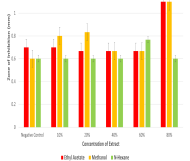
Tembe Nggoli is a traditional woven fabric from Bima City, Indonesia, produced using natural cotton yarn with hygroscopic properties that enhance comfort but also support bacterial growth, potentially leading to skin irritation or infections. The aim of this study was to evaluate the potential of bioactive compounds from Sargassum sp. as antibacterial agents and their role in enhancing the functional properties of Tembe Nggoli fabric. Bioactive compounds were extracted through microwave-assisted extraction (MAE) using ethyl acetate, methanol, and n-hexane, followed by liquid-liquid fractionation. The chemical profiles were subjected to rigorous analysis using Fourier-transform infrared (FT-IR) spectroscopy and gas chromatography-mass spectrometry (GC-MS). FT-IR analysis confirmed the presence of functional groups such as hydroxyl (O–H), alkyl (C–H), carbonyl (C=O), and ether (C–O), signifying the presence of various bioactive constituents. However, GC-MS analysis identified hexadecanoic acid as the predominant compound, which was well-documented for the established antibacterial properties. The ethyl acetate extract had the most significant inhibition against S. aureus, with zones measuring 1.20 mm at 80% concentration (Agar Well Diffusion) and 1.16 mm at 40% concentration (paper disk). The extract had a diminished activity against E. coli, suggesting enhanced resistance. The results showed that Sargassum sp. extract, particularly the type derived from ethyl acetate, could enhance the antibacterial properties of cotton-based textiles such as Tembe Nggoli. The use of natural antibacterial agents would enhance the hygienic quality of the fabric as well as contribute to the sustainable development and added value of traditional textile products.
Downloads
Article Details
Section

This work is licensed under a Creative Commons Attribution-NonCommercial-NoDerivatives 4.0 International License.
How to Cite
References
1.Rizal AM, Ningsih NS. Description and variation of ocean wave energy in Indonesian seas and adjacent waters. Ocean Eng. 2022; 251:111086. Doi:10.1016/j.oceaneng.2022.111086 DOI: https://doi.org/10.1016/j.oceaneng.2022.111086
2.Kiuru P, DʼAuria M, Muller C, Tammela P, Vuorela H, Yli-Kauhaluoma J. Exploring Marine Resources for Bioactive Compounds. Planta Med. 2014; 80(14):1234-1246. Doi:10.1055/s-0034-1383001 DOI: https://doi.org/10.1055/s-0034-1383001
3.Puspita M, Setyawidati NAR, Stiger-Pouvreau V, Vandanjon L, Widowati I, Radjasa OK, Bedoux G, Bourgougnon N. Indonesian Sargassum species bioprospecting: potential applications of bioactive compounds and challenge for sustainable development. Adv Bot Res. 2020; 95:113-161. Doi:10.1016/bs.abr.2019.12.002 DOI: https://doi.org/10.1016/bs.abr.2019.12.002
4.Widowati I, Puspita M, Stiger-Pouvreau V, Bourgougnon N. Potentiality of Using Spreading Sargassum Species from Indonesia as an Interesting Source of Antibacterial and Radical Scavenging Compounds: A Preliminary Study. Int J Mar Aquat Resour Conserv Coexist. 2014; 1(1):63-67.
5.Møllebjerg A, Palmén LG, Gori K, Meyer RL. The Bacterial Life Cycle in Textiles is Governed by Fiber Hydrophobicity. Microbiol Spectr. 2021; 9(2):e01185-21. Doi:10.1128/Spectrum.01185-21 DOI: https://doi.org/10.1128/Spectrum.01185-21
6.Baseer RA, Taha GM, Kassem AF, Khalil R.Modified cotton fabrics with poly (3-(furan-2-carboamido) propionic acid) and poly (3-(furan-2-carboamido) propionic acid)/gelatin hydrogel for UV protection, antibacterial and electrical properties. Arab J Chem. 2020; 13(6):5614-5626. Doi:10.1016/j.arabjc.2020.04.001 DOI: https://doi.org/10.1016/j.arabjc.2020.04.001
7.Velmurugan P, Lee SM, Cho M, Park JH, Seo SK, Myung H, Bang KS, Oh BT. Antibacterial activity of silver nanoparticle-coated fabric and leather against odor and skin infection causing bacteria. Appl Microbiol Biotechnol. 2014; 98(19):8179-8189. Doi:10.1007/s00253-014-5945-7 DOI: https://doi.org/10.1007/s00253-014-5945-7
8.Sfameni S, Hadhri M, Rando G, Drommi D, Rosace G, Trovato V, Plutino MR. Inorganic Finishing for Textile Fabrics: Recent Advances in Wear-Resistant, UV Protection and Antimicrobial Treatments. Inorganics. 2023; 11(1):19. Doi:10.3390/inorganics11010019 DOI: https://doi.org/10.3390/inorganics11010019
9.Xu W, Xu L, Pan H, Li K, Li J, Wang L, Shen Y, Liu Y, Li T. Robust ZnO/HNTs-based superhydrophobic cotton fabrics with UV shielding, self-cleaning, photocatalysis, and oil/water separation. Cellulose. 2022; 29(7):4021-4037. Doi:10.1007/s10570-022-04462-4 DOI: https://doi.org/10.1007/s10570-022-04462-4
10.Chruściel JJ. Modifications of Textile Materials with Functional Silanes, Liquid Silicone Softeners, and Silicone Rubbers—A Review. Polymers. 2022; 14(20):4382. Doi:10.3390/polym14204382 DOI: https://doi.org/10.3390/polym14204382
11.Haji A, Nasiriboroumand M, Qavamnia SS. Cotton Dyeing and Antibacterial Finishing Using Agricultural Waste by an Eco-friendly Process Optimized by Response Surface Methodology. Fibers Polym. 2018; 19(11):2359-2364. Doi:10.1007/s12221-018-8657-2 DOI: https://doi.org/10.1007/s12221-018-8657-2
12.Suneeta, Harlapur S, Harlapur SF. Enhancement of antibacterial properties of cotton fabric by using neem leaves extract as dye. Mater Today Proc. 2021; 44:523-526. Doi:10.1016/j.matpr.2020.10.209 DOI: https://doi.org/10.1016/j.matpr.2020.10.209
13.Matos GS, Pereira SG, Genisheva ZA, Gomes AM, Teixeira JA, Rocha CMR. Advances in Extraction Methods to Recover Added-Value Compounds from Seaweeds: Sustainability and Functionality. Foods. 2021; 10(3):516. Doi:10.3390/foods10030516 DOI: https://doi.org/10.3390/foods10030516
14.Susanna D, Balakrishnan RM, Ponnan EJ. Comprehensive insight into the extract optimization, phytochemical profiling, and biological evaluation of the medicinal plant Nothapodytes foetida. Biocatal Agric Biotechnol. 2022; 42:102365. Doi:10.1016/j.bcab.2022.102365 DOI: https://doi.org/10.1016/j.bcab.2022.102365
15.Linz MS, Mattappallil A, Finkel D, Parker D. Clinical Impact of Staphylococcus aureus Skin and Soft Tissue Infections. Antibiotics. 2023; 12(3):557. Doi:10.3390/antibiotics12030557 DOI: https://doi.org/10.3390/antibiotics12030557
16.Nautiyal V, Dubey RC. FT-IR and GC-MS analyses of potential bioactive compounds of cow urine and its antibacterial activity. Saudi J Biol Sci. 2021; 28(4):2432-2437. Doi:10.1016/j.sjbs.2021.01.041 DOI: https://doi.org/10.1016/j.sjbs.2021.01.041
17.Ashraf SA, Al-Shammari E, Hussain T, Tajuddin S, Panda BP. In-vitro antimicrobial activity and identification of bioactive components using GC–MS of commercially available essential oils in Saudi Arabia. J Food Sci Technol. 2017; 54(12):3948-3958. Doi:10.1007/s13197-017-2859-2 DOI: https://doi.org/10.1007/s13197-017-2859-2
18.Datu SS, Angraeni, Fatwasari F, Jarir DV, Sabilah AA. Antibacterial screening of Sargassum sp extract Opposing Vibrio parahaemolyticus bacteria. Makassar Sci J. 2024; 2(1):288-295. Doi:10.61942/msj.v2i1.94 DOI: https://doi.org/10.61942/msj.v2i1.94
19.Zamimi NN, Halim NA, Darni̇s D, Lestari W, Mustafa MS. Gas chromatography-mass spectrometry analysis of phytocomponents of Sargassum polycystum. Int J Res Pharm Sci. 2019. doi:10.26452/IJRPS.V10I4.1533 DOI: https://doi.org/10.26452/ijrps.v10i4.1533
20.Kordjazi M, Etemadian Y, Shabanpour B, Pourashouri P. Chemical composition antioxidant and antimicrobial activities of fucoidan extracted from two species of brown seaweeds (Sargassum ilicifolium and Sargassum angustifolium) around Qeshm Island. Iran J Fish Sci. 2019; 18(3):457-475.
21.Rajivgandhi GN, Kanisha CC, Ramachandran G, Manoharan N, Mothana RA, Siddiqui NA, Al-Rehaily AJ, Ullah R, Almarfadi OM. Phytochemical screening and anti-oxidant activity of Sargassum wightii enhances the anti-bacterial activity against Pseudomonas aeruginosa. Saudi J Biol Sci. 2021; 28(3):1763-1769. Doi:10.1016/j.sjbs.2020.12.018 DOI: https://doi.org/10.1016/j.sjbs.2020.12.018
22.Firdaus M, Kartikaningsih H, Sulifah U. Sargassum spp extract inhibits the growth of foodborne illness bacteria. AIP Conf Proc. 2019; 2202(1):020083. Doi:10.1063/1.5141696 DOI: https://doi.org/10.1063/1.5141696
23.Nofal A, Azzazy M, Ayyad S, Abdelsalm E, Abousekken MS, Tammam O. Evaluation of the brown alga, Sargassum muticum extract as an antimicrobial and feeding additives. Braz J Biol. 2022; 84:e259721. Doi:10.1590/1519-6984.259721 DOI: https://doi.org/10.1590/1519-6984.259721
24.Rajan DK, Mohan K, Zhang S, Ganesan AR. Dieckol: a brown algal phlorotannin with biological potential. Biomed Pharmacother. 2021; 142:111988. Doi:10.1016/j.biopha.2021.111988 DOI: https://doi.org/10.1016/j.biopha.2021.111988
25.Albratty M, Alhazmi HA, Meraya AM, Najmi A, Alam MS, Rehman Z, Moni SS. Spectral analysis and Antibacterial activity of the bioactive principles of Sargassum tenerrimum J. Agardh collected from the Red sea, Jazan, Kingdom of Saudi Arabia. Braz J Biol. 2021; 83:e249536. Doi:10.1590/1519-6984.249536 DOI: https://doi.org/10.1590/1519-6984.249536
26.Martins C de M, Nascimento EA do, de Morais SAL, de Oliveira A, Chang R, Cunha LC, Martins MM, Martins CH, Moraes TD, Rodrigues PV, Silva CV. Chemical Constituents and Evaluation of Antimicrobial and Cytotoxic Activities of Kielmeyera coriacea Mart. & Zucc. Essential Oils. Evid Based Complement Alternat Med. 2015; 2015(1):842047. Doi:10.1155/2015/842047 DOI: https://doi.org/10.1155/2015/842047
27.Kamaraj M, Dhana Rangesh Kumar V, Nithya TG, Danya U. Assessment of Antioxidant, Antibacterial Activity and Phytoactive Compounds of Aqueous Extracts of Avocado Fruit Peel from Ethiopia. Int J Pept Res Ther. 2020; 26(3):1549-1557. Doi:10.1007/s10989-019-09965-6 DOI: https://doi.org/10.1007/s10989-019-09965-6
28.Endris YA, Abdu KY, Abate SG. Investigation of bioactive phytochemical compounds of the Ethiopian medicinal plant using GC-MS and FTIR. Heliyon. 2024; 10(15). Doi:10.1016/j.heliyon.2024.e34687 DOI: https://doi.org/10.1016/j.heliyon.2024.e34687
29.Das S, Das A, Thamarai SR, Raj SA. The antibacterial and aroma finishing of cotton fabrics by Mentha pipertia extract. J Text Inst. 2021; 112(7):1181-1190. Doi:10.1080/00405000.2020.1805194 DOI: https://doi.org/10.1080/00405000.2020.1805194
30.Andra S, Muthalagu M, Jeevanandam J, Sekar DD, Ramamoorthy R. Evaluation and development of antibacterial fabrics using Pongamia pinnata extracts. Res J Text Appar. 2019; 23(3):257-268. Doi:10.1108/RJTA-10-2018-0059 DOI: https://doi.org/10.1108/RJTA-10-2018-0059
31.Thakker AM, Sun D. Sustainable plant-based bioactive materials for functional printed textiles. J Text Inst. 2021; 112(8):1324-1358. Doi:10.1080/00405000.2020.1810474 DOI: https://doi.org/10.1080/00405000.2020.1810474