


Dietary Zingiber officinale (Ginger) Supplementation Ameliorates Lead Carbonate-Induced Hepato-Renal Toxicity and Inflammation in Female Wistar Rats
Article Sidebar
Views | PDF/EPUB Downloads:
0
/ 0
/ 0
Main Article Content
Abstract
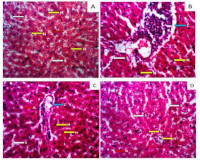
In low and middle-income countries, lead contamination remains a significant public health threat due to weak regulatory enforcement. Lead exposure induces oxidative stress and systemic inflammation, leading to liver and kidney dysfunction. This study aimed to investigate the ameliorative effects of dietary ginger (Zingiber officinale) supplementation against lead-induced damage in Wistar rats. Female Wistar rats were divided into four groups (n = 6): Control (A); lead carbonate (30 mg/kg/day, oral) (B); lead + 1% ginger diet (C); and lead + 5% ginger diet (D) for 28 days. Serum levels of creatinine, aspartate aminotransferase (AST), alanine aminotransferase (ALT), malondialdehyde (MDA), total antioxidant capacity (TAC), tumor necrosis factor-alpha (TNF-α), interleukin-6 (IL-6), interleukin-10 (IL-10), and liver histology were assessed.
Lead exposure significantly (p < 0.05) elevated markers of hepato-renal injury (creatinine, AST, and ALT), increased the oxidative stress marker (MDA), and raised pro-inflammatory cytokines (TNF-α, IL-6). Conversely, it depleted the total antioxidant capacity (TAC) and the anti-inflammatory cytokine IL-10, while inducing severe liver histopathological damage compared to the control group (Group A). Dietary ginger supplementation dose-dependently attenuated these lead-induced alterations. Notably, the 5% ginger diet (Group D) significantly (p < 0.05) reduced all markers of organ damage and inflammation, decreased MDA, and increased both TAC and IL-10 levels compared to Group B. In conclusion, dietary ginger, particularly at a 5% supplementation level, demonstrates significant protective effects against lead-induced hepato-renal toxicity, oxidative stress, and inflammation in rats, highlighting its potential as a natural hepato-renal protective agent.
Downloads
Article Details
Section

This work is licensed under a Creative Commons Attribution-NonCommercial-NoDerivatives 4.0 International License.
How to Cite
References
1.Ericson B, Hu H, Nash E, Ferraro G, Sinitsky J, Taylor MP. Blood lead levels in low-income and middle-income countries: A systematic review. Lancet Planet Health. 2021; 5(3):e145–e153. doi:10.1016/S2542-5196(20)30278-3.
2.Larsen B and Sánchez-Triana E. Global health burden and cost of lead exposure in children and adults: A health impact and economic modelling analysis. Lancet Planet Health. 2023; 7(10):e831–e840. doi:10.1016/s2542-5196(23)00166-3.
3.Ericson B, Landrigan PJ, Taylor MP, Frostad J, Caravanos J, Keith J, Fuller R. The global burden of lead toxicity attributable to informal used lead-acid battery recycling. Ann Glob Health. 2021; 87(1):66. doi:10.5334/aogh.3235
4.Rezaee M, Esfahani Z, Nejadghaderi SA, Abbasi-Kangevari M, Saeedi Moghaddam S, Ghanbari A, Ghamari A, Golestani A, Foroutan Mehr E, Kazemi A, Haghshenas R, Moradi M, Kompani F, Rezaei N, Larijani B. Estimating the burden of diseases attributable to lead exposure in the North Africa and Middle East region, 1990-2019: A systematic analysis for the Global Burden of Disease study 2019. Environ Health. 2022; 21(1):105. doi:10.1186/s12940-022-00914-3.
5.Hernberg S. Lead poisoning in a historical perspective. Am J Ind Med. 2000; 38(3):244–254.
6.Meyer PA, Brown MJ, Falk H. Global approach to reducing lead exposure and poisoning. Mutat Res Rev Mutat Res. 2008; 659(1-2):166–175. doi:10.1016/j.mrrev.2008.03.003
7.Hsu PC and Guo YL. Antioxidant nutrients and lead toxicity. Toxicol. 2002; 180(1):33–44. doi:10.1016/S0300-483X(02)00380-3
8.De Silva PE. Determination of lead in plasma and studies on its relationship to lead in erythrocytes. Br J Ind Med. 1981; 38(3):209–217. doi:10.1136/oem.38.3.209.
9.Sharma RP and Street JC. Public health aspects of toxic heavy metals in animal feeds. J Am Vet Med Assoc. 1980; 177(2):149–153.
10.Humphreys DJ. Effects of exposure to excessive quantities of lead on animals. Br Vet J. 1991; 147(1):18–30. doi:10.1016/0007-1935(91)90063-S.
11.Lancranjan I, Popescu HI, Gavenescu O, Klepsch I, Serbanescu M. Reproductive ability of workmen occupationally exposed to lead. Arch Environ Health. 1975; 30(8):396–401. doi:10.1080/00039896.1975.10666733.
12.Rom WN. Effects of lead on reproduction. In: Infante PF, Legator MS, editors. Proceedings of the Workshop on Methodology for Assessing Reproductive Hazards in the Workplace. National Institute for Occupational Safety and Health; 1980. p. 33–42.
13.Gurer H and Ercal N. Can antioxidants be beneficial in the treatment of lead poisoning? Free Radic Biol Med. 2000; 29(10):927–945. doi:10.1016/S0891-5849(00)00413-5.
14.Afzal S, Abdul Manap AS, Attiq A, Albokhadaim I, Kandeel M, Alhojaily SM. From imbalance to impairment: The central role of reactive oxygen species in oxidative stress-induced disorders and therapeutic exploration. Front Pharmacol. 2023; 14:1269581. doi:10.3389/fphar.2023.1269581.
15.Shalan MG. Mitigating lead acetate-induced histopathologic and physiologic disorders in rats receiving vitamin C and glutathione supplement. Heliyon. 2024; 11(1):e41256. doi:10.1016/j.heliyon.2024.e41256.
16.Zhai Q, Narbad A, Chen W. Dietary strategies for the treatment of cadmium and lead toxicity. Nutrients. 2015; 7(1):552–571. doi:10.3390/nu7010552.
17.Ngwatshipane MM and Otang-Mbeng W. The therapeutic and phytopharmacological potential of ginger (Zingiber officinale). In: Eddouks M, editor. Ginger - Cultivation, bioactive compounds and medicinal properties. IntechOpen; 2023. doi:10.5772/intechopen.105900.
18.Bode AM and Dong Z. The amazing and mighty ginger. In: Benzie IFF, Wachtel-Galor S, editors. Herbal medicine: Biomolecular and clinical aspects. 2nd ed. CRC Press/Taylor & Francis; 2011. Chapter 7. Available from: https://www.ncbi.nlm.nih.gov/books/NBK92775/
19.Mao QQ, Xu XY, Cao SY, Gan RY, Corke H, Beta T, Li HB. Bioactive compounds and bioactivities of ginger (Zingiber officinale Roscoe). Foods. 2019; 8(6):185. doi:10.3390/foods8060185.
20.Moghaddam SH, Vatankhah A, Armide N, Keshavarzi Z. Revisiting the protective effects of ginger phenolic compounds on the kidneys: A narrative review. Food Hum. 2024; 3:100442. doi:10.1016/j.foohum.2024.100442.
21.Reddy YA, Chalamaiah M, Ramesh B, Balaji G, Indira P. Ameliorating activity of ginger (Zingiber officinale) extract against lead induced renal toxicity in male rats. J Food Sci Technol. 2014; 51(5):908–914. doi:10.1007/s13197-011-0568-9
22.Gabr SA, Alghadir AH, Ghoniem GA. Potential prophylactic and therapeutic effects of Zingiber officinale on lead-induced cardiac and hepatic toxicity in rats. J Food Drug Anal. 2017; 25(4):974–983. doi:10.1016/j.jfda.2016.11.003.
23.Ojo FO, Hassan LA, Olaniyi OS, Adetoro EK, Lawal RT, Lawal MB. Zingiber officinale supplemented diet reversed lead-induced oxidative stress and cerebral cortex injuries in adult female Wistar rats. J Exp Clin Anat. 2025; 22(1):22–26.
24.Onaolapo AY, Ojo FO, Onaolapo OJ. Biflavonoid quercetin protects against cyclophosphamide-induced organ toxicities via modulation of inflammatory cytokines, brain neurotransmitters, and astrocyte immunoreactivity. Food Chem Toxicol. 2023; 178:113879. doi:10.1016/j.fct.2023.113879.
25.Shanmugam L, Sadashiva C, Narayanan PR, Janardhanam BS, Suresh PS, Ramachandran R, Perumal V, Swaminathan S. Evaluation of TNF-α, IL-10 and IL-6 Cytokine Production and Their Correlation with Genotype Variants among Tuberculosis Patients. PLoS One. 2015; 11;10(9):e0137727. doi:10.1371/journal.pone.0137727.
26.Offiong I, Ajibade A, Ojo F, Kehinde B, Pelumi F. Effects of vitamin C on aluminum chloride-induced neurotoxicity on the hippocampal cortex of adult Wistar male rats. Asian J Med Health. 2024; 22(10):80-101
27.Assi MA, Hezmee MN, Haron AW, Sabri MY, Rajion MA. The detrimental effects of lead on human and animal health. Vet World. 2016; 9(6):660–671. doi:10.14202/vetworld.2016.660-671.
28.Amarnath Reddy Y, Chalamaiah M, Ramesh B, Balaji G, Indira P. Ameliorating activity of ginger (Zingiber officinale) extract against lead induced renal toxicity in male rats. Trop J Nat Prod Res. 2014; 51(5):908-914 2014 May. PMCID: PMC4008737
29.Lawal MB, Hassan LA, Ojo FO, Adetoro EK, Lawal RT, Olayemi OS, Oladele OM, Aderibigbe OY. Therapeutic potential of ginger-supplemented diet in reversing lead-induced nephrotoxicity. Asian J Med Health. 2025; 23(2):54–61. doi:10.9734/ajmah/2025/v23i21175
30.Hassan LA, Folorunso KP, Kehinde EA, Afolabi O, Olawale AA, Lawal MB. Dietary supplementation with powdered ginger root ameliorates lead carbonate-induced ovarian injuries in adult Wistar rats. Acta Bioscientia. 2025; 1(3):134–139. doi:10.71181/actioscientia12280.
31.Thakur S, Kumar V, Das R, Sharma V, Mehta DK. Biomarkers of hepatic toxicity: An overview. Curr Ther Res. 2024; 100:100737. doi:10.1016/j.curtheres.2024.100737.
32.Rastogi SK. Renal effects of environmental and occupational lead exposure. Indian J Occup Environ Med. 2008; 12(3):103–106. doi:10.4103/0019-5278.44689.
33.Patra RC, Rautray AK, Swarup D. Oxidative stress in lead and cadmium toxicity and its amelioration. Vet Med Int. 2011; 2011:457327. doi:10.4061/2011/457327.