


Performance of Ipomoea batatas L. Pigment as a pH Strip and Acid–Base Titration Indicator
Article Sidebar
Views | PDF/EPUB Downloads:
0
/ 0
/ 0
Main Article Content
Abstract
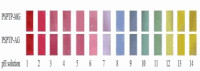
Purple sweet potato tubers (PSPT) are rich in anthocyanins, pigments that exhibit visible colour changes across varying pH levels. This study aims to evaluate the performance of PSPT pigment (PSPTP) as both a pH strip and a titration indicator for strong acid–strong base (SASB), strong acid–weak base (SAWB), weak acid–strong base (WASB), and weak acid–weak base (WAWB) titrations. PSPTP was extracted from dried tubers using medical-grade (MG) and analytical-grade (AG) ethanol, resulting in PSPTP-MG and PSPTP-AG, respectively. Strips were fabricated by immobilizing the extracts on cellulose paper, producing PSPTPIP-MG and PSPTPIP-AG. The strips were unchanged at pH 1–7, pale blue at pH 8–9, green at pH 10–12, and yellow at pH 13–14. PSPTPIP-MG was stable for 14 days, while PSPTPIP-AG lasted 21 days; both gradually faded but retained acceptable stability for up to 180 days. They demonstrated excellent sensitivity and produced clear results when applied to household chemicals. As titration indicators, PSPTP-MG and PSPTP-AG showed good precision (CV 0.09%–1.17%) across all titration types but were accurate only for SASB and SAWB titrations (recovery 102.4%–102.5%). In the analysis of pharmaceutical samples, SASB and SAWB titrations yielded acid concentrations of 0.042 M for PSPTP-MG and PSPTP-AG, and 0.041 M for phenolphthalein (PP) in unspiked samples, while spiked samples yielded 0.165 M with all three indicators. Overall, this study demonstrates that PSPTP performs effective as both a pH strip and a titration indicator, particularly for SASB and SAWB titrations.
Downloads
Article Details
Section

This work is licensed under a Creative Commons Attribution-NonCommercial-NoDerivatives 4.0 International License.
How to Cite
References
1.Huang J, Wang Q, Qiu Q. Physiological Studies on Anthocyanin Accumulation, Quality and Yield of Purple Sweet Potato Tubers with Different Forms of Potassium Fertilizer. Sci Horticult. 2025; 343:1-12. doi:10.1016/j.scienta.2025.114094.
2.Alam FM, Kurnianingsih N, Fatchiyah F. Phytochemical Analysis of Purple Sweet Potatoes (Ipomoea batatas) Roots Extract from Lawang and Kawi Mountain Cultivar, East Java, Indonesia. J Exp Life Sci. 2022; 12(1):17-22. doi:10.21776/ub.jels.2022.012.01.03.
3.Budiman MR, Wiraswati HL, Rezano A. Purple Sweet Potato Phytochemicals: Potential Chemo-Preventive and Anticancer Activities. Open Access Maced J Med Sci. 2021; 9:288-298. doi:10.3889/oamjms.2021.6784.
4.Hu H, Zhou X, Zhang Y, Zhou W, Zhang L. Influences of Particle Size and Addition Level on the Rheological Properties and Water Mobility of Purple Sweet Potato Dough. Foods. 2023; 12(2):1-13. doi:10.3390/ foods12020398.
5.Wu H, Oliveira G, Lila MA. Protein-Binding Approaches for Improving Bioaccessibility and Bioavailability of Anthocyanins. Compr Rev Food Sci Food Saf. 2023; 22(1):333-354. doi:10.1111/1541-4337.13070.
6.Jenimat AD, Lawung YD, Baunsele AB, Boelan EG, Leba MAU. Phytochemical Content of Fresh Purple Sweet Potato (Ipomea batatas L.) Extract as Acid-Base Titration Indicator. J Sains Nat. 2023; 13(2):57-66.
7.Liu T, Peng W, Pang S, Peng Z, Qi W, Wang Y. Research Progress on Functional Activity and Utilization of Cereal Anthocyanins. Sci Technol Food Ind. 2023; 44(1):447-457. doi:10.13386/j.issn1002-0306.2022030103.
8.Im YR, Kim I, Lee J. Phenolic Composition and Antioxidant Activity of Purple Sweet Potato (Ipomoea batatas (L.) lam.): Varietal Comparisons and Physical Distribution. Antioxidants. 2021; 10(3):1-17. doi:10.3390/antiox 10030462.
9.Wang F, Zhang S, Deng G, Xu K, Xu H, Liu J. Extracting Total Anthocyanin from Purple Sweet Potato Using an Effective Ultrasound-Assisted Compound Enzymatic Extraction Technology. Molecules. 2022; 27(14):1-15. doi:10.3390/molecules27144344.
10.Rahmadhia SN, Saputra YA, Juwitaningtyas T, Rahayu W. Intelligent Packaging as A pH-Indicator Based on Cassava Starch with Addition of Purple Sweet Potato Extract (Ipomea batatas L.). J Funct Food Nutraceutical. 2022; 4(1):37-47. doi:10.33555/jffn.v4i1.90.
11.Rein M. Copigmentation Reactions and Color Stability of Berry Anthocyanins. Academic Dissertation, Department of Applied Chemistry and Microbiology Food Chemistry Division. 2005; 1-87.
12.Lucas-González R, Pateiro M, Domínguez-Valencia R, Carrillo C, Lorenzo JM. Optimization of Anthocyanin Extraction from Purple Sweet Potato Peel (Ipomea batata) Using Sonotrode Ultrasound-Assisted Extraction. Foods. 2025; 14(15):1-18. doi:10.3390/foods14152686.
13.Gamage GCV and Choo WS. Thermal and pH Stability of Natural Anthocyanin Colourant Preparations from Black Goji Berry. Food Chem Adv. 2023; 2:1-11. doi:10.1016/j.focha.2023.100236.
14.Chen CC, Lin C, Chen MH, Chiang PY. Stability and Quality of Anthocyanin in Purple Sweet Potato Extracts. Foods. 2019; 8(393):1-13. doi:10.3390/foods8090393.
15.Yun D, Wu Y, Yong H. Recent Advances in Purple Sweet Potato Anthocyanins: Extraction, Isolation, Functional Properties and Applications in Biopolymer-Based Smart Packaging. Foods. 2024; 13(21):1-31. doi:10.3390/foods 13213485.
16.Rusdianto AS and Ramadhan DW. Smart Label with Color Indicator Made of Purple Sweet Potato (Ipomoea batatas L.) on The Bottle Packaging of Pasteurized Milk. Int J Food Agric Nat Resour. 2021; 2(3):12-19. doi:10.46676/ij-fanres.v2i3.35.
17.Vadivel E and Chipkar SD. Eco-Friendly Natural Acid-Base Indicator Properties of Four Flowering Plants from Western Ghats. Int J Pharm Pharm Sci. 2016; 8(6):250-252.
18.Zhang X, Lu S, Chen X. A Visual pH Sensing Film Using Natural Dyes from Bauhinia blakeana Dunn. Sensors Actuators, B Chem. 2014; 198:268-273. doi:10.1016/j.snb.2014.02.094.
19.Bria HR, Leba MAU, Kopon AM. Fabrication of Natural Indicator Paper from Purple Sweet Potato (Ipomoea batatas L.) Tuber Extract. In: “National Seminar on Chemistry and Chemistry Education (SN-KPK) 2021: Strengthening the Role of Chemistry and Chemistry Education in Sustainable Development for Humanity and Civilization.” FST UIN Walisongo; 2021; 33-42.
20.Leba MAU, Mau SDB, Boelan EG, Taek MM, Ruas JC, Tukan MB. Exploring Purple Sweet Potato Pigment as An Eco-Friendly Titration Indicator for Acid Determination. Trop J Nat Prod Res. 2024; 8(6):7403-7409.
21.Sohany M, Tawakkal ISMA, Ariffin SH, Shah NNAK, Yusof YA. Characterization of Anthocyanin Associated
22.Purple Sweet Potato Starch and Peel-Based pH Indicator Films. Foods. 2021; 10(9):1-27. doi:10.3390/foods100 92005.
23.Jiang G, Hou X, Zeng X, Zhang C, Wu H, Shen G. Preparation and Characterization of Indicator Films from Carboxymethyl-Cellulose/Starch and Purple Sweet Potato (Ipomoea batatas (L.) lam) Anthocyanins for Monitoring Fish Freshness. Int J Biol Macromol. 2020; 143:359-372. doi:10.1016/j.ijbiomac.2019.12.024.
24.Hasan M, Utami A, Siregar C, Hanum L, Khaldun I, Nazar M. Thermal, Structural and Mechanical Characterization of Bio-Nanocomposite Films from Purple Sweet Potato Starch/Chitosan Nanoparticles Integrated with Anthocyanin Extract. Results Eng. 2025; 25(1):1-9. doi:10.1016/j.rineng .2025.104448.
25.Afandy MA, Nuryanti S, Diah AWM. Extraction of Purple Sweet Potato (Ipomoea batatas L.) Using Solvent Variation and Its Utilization as Acid-Base Indicator. J Akad Kim. 2017; 6(2):79-85. doi:10.22487/j24775185.2017.v6.i2.9237.
26.Leba MAU, Mau SDB, Boelan EG, Taek MM, Ruas JC, Lawung YD. Pigments of Purple Sweet Potato and Turmeric Rhizome: Eco-Friendly and Cheap Indicators for Acid-Base. J Indones Soc Integr Chem. 2023; 15(2):99-109. doi:10.22437/jisic.v15i2.28648.
27.Choi I, Lee JY, Lacroix M, Han J. Intelligent pH Indicator Film Composed of Agar/Potato Starch and Anthocyanin Extracts from Purple Sweet Potato. Food Chem. 2017; 218:122-128. doi:10.1016/j.foodchem.2016.09.050.
28.Wasito H, Karyati E, Vikarosa CD, Hafizah IN, Utami HR. pH Test Strips from Natural Ingredients Immobilized in Cellulose Paper. Indones J Chem Sci. 2017; 6(3):223-229.
29.Hoa VT, Thang NQ, Tan LV, Tran LTT. Exploring Plant Species in Vietnam for the Production of pH Indicator Paper. Trop J Nat Prod Res. 2023; 7:4889-4893.
30.Leba MAU, Baunsele AB, Mau SDB, Taek MM, Ruas NA, Ruas AC, Tukan MB, Boelan EG, Komisia F. Development and Validation of Purple Sweet Potato (Ipomea batatas L.) Pigment as a Titrimetric Indicator for Hydrochloric Acid Quantification. Trop J Nat Prod Res. 2025; 9(5):1933-1938.
31.Leba MAU, Tukan MB, Komisia F. pH Indicator Paper by Immobilizing Turmeric Rhizome Ethanol Extract on Filter Paper. J Sains Nat. 2022; 12(2):45-53.
32.Dangles O, Fenger JA. The Chemical Reactivity of Anthocyanins and its Consequences in Food Science and Nutrition. Molecules. 2018; 23(8):1-23. doi:10.3390/ molecules23081970.
33.Halász K, Kóczán Z, Joóbné Preklet E. pH-Dependent Color Response of Cellulose-Based Time-Temperature Indicators Impregnated with Red Cabbage Extract. J Food Meas Charact. 2023; 17:2555–2565. doi:10.1007/s11694-023-01805-y.