


Phytochemical Composition, Antioxidant, and Acetylcholinesterase Inhibitory Activities of Pluchea pteropoda Extract
Article Sidebar
Views | PDF/EPUB Downloads:
0
/ 0
/ 0
Main Article Content
Abstract
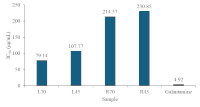
Pluchea pteropoda (Asteraceae) has been traditionally employed in folk medicine; however, its phytochemical characteristics and biological activities remain insufficiently defined. This study aimed to elucidate the phytochemical composition, antioxidant properties, and acetylcholinesterase (AChE) inhibitory potential of leaf and root extracts prepared using 45% and 70% ethanol. Four extracts of 45% ethanol extract of leaves (L45), 70% ethanol extract of leaves (L70), 45% ethanol extract of roots (R45), and 70% ethanol extract of roots (R70) were obtained and subjected to qualitative phytochemical screening, quantitative determination of total phenolic and flavonoid contents, DPPH radical scavenging and FRAP reducing power assays, as well as AChE inhibition assessment via Ellman’s method. Data were analyzed using regression-based IC50 estimation and reported as the mean of triplicate measurements. Leaf extracts exhibited substantially higher phenolic (up to 52.89 mg GAE/g) and flavonoid contents (20.62 mg QE/g) compared to root extracts. Antioxidant performance varied according to solvent strength: L45 demonstrated the most potent DPPH scavenging activity (IC50 = 194.8 µg/mL), whereas L70 showed superior reducing capability. AChE inhibitory activity followed the order L70 > L45 > R70 > R45, although L70 remained approximately 16 times less potent than galantamine. Collectively, the findings indicate that P. pteropoda possesses noteworthy antioxidant potential and moderate AChE inhibition, suggesting its promise as a natural source for the development of phytotherapies targeting oxidative stress and neurodegenerative disorders.
Downloads
Article Details
Section

This work is licensed under a Creative Commons Attribution-NonCommercial-NoDerivatives 4.0 International License.
How to Cite
References
1.Dontha S. A review on antioxidant methods. Asian J Pharm Clin Res. 2016; 9(2):14-32.
2.Amoo SO, Aremu AO, Moyo M, Van Staden J. Antioxidant and acetylcholinesterase-inhibitory properties of long-term stored medicinal plants. BMC Complement Altern Med. 2012; 12:1-9.
3.Durmaz L, Erturk A, Akyüz M, Kose LP, Uc EM, Bingol Z, Saglamtas R, Alwasel S, Gulcin İ. Screening of carbonic anhydrase, acetylcholinesterase, butyrylcholinesterase, and α-glycosidase enzyme inhibition effects and antioxidant activity of coumestrol. Molecules. 2022; 27(10):3091.
4.Ranjan N, Kumari M. Acetylcholinesterase inhibition by medicinal plants: A Review. Ann Plant Sci. 2017; 6(06):1640-1644.
5.Iheanacho CM, Akubuiro PC, Oseghale IO, Imieje VO, Erharuyi O, Ogbeide KO, Jideonwo AN, Falodun A. Evaluation of the Antioxidant Activity of the Stem Bark Extracts of Anacardium occidentale (Linn) Anacardiaceae. Trop J Phytochem Pharm Sci. 2023; 2(2):65-69.
6.Shadat AA, Ibrahim AY, Ezzeldin E, Alsaid MS. Acetylcholinesterase inhibition and antioxidant activity of some medicinal plants for treating neuro degenerative disease. Afr. J Tradit Complement Altern Med. 2015; 12(3):97-103.
7.Okolie NP, Falodun A, Davids O. Evaluation of the antioxidant activity of root extract of pepper fruit (Dennetia tripetala), and its potential for the inhibition of lipid peroxidation. Afr. J Tradit Complement Altern Med. 2014; 11(3):221-227.
8.Shaikh JR, Patil M. Qualitative tests for preliminary phytochemical screening: An overview. Int. J Chem. Stud. 2020; 8(2):603-608.
9.Deepa AV, Dennis Thomas T. Plant extracts and phytochemicals targeting Alzheimer’s through acetylcholinesterase inhibition. Open Exploration. 2025; 4:e100697.
10.Jiang Y, Gao H, Turdu G. Traditional Chinese medicinal herbs as potential AChE inhibitors for anti-Alzheimer’s disease: A review. Bioorg Chem. 2017; 75:50-61.
11.Hussain H, Al-Harrasi A, Abbas G, Ur Rehman N, Mabood F, Ahmed I, Saleem M, van Ree T, Green IR, Anwar S, Badshah A, Shah A, Ali I. The genus Pluchea: Phytochemistry, traditional uses, and biological activities. Chem. Biodivers. 2013; 10(11):1944-1971.
12.Sharma SK, Goyal N. Biological studies of the plants from genus Pluchea. Ann Biol. Res. 2011; 2(3):25-34.
13.Ahemd SA, Kamel EM. Phenolic constituents and biological activity of the genus Pluchea. Der Pharma Chemica. 2013; 5(5):109-114.
14.Thinh BB, Thin DB. Essential oil composition, antimicrobial and antioxidant properties of Pluchea eupatorioides Kurz collected from Vietnam. J Essent Oil Bear Plants. 2023; 26(3):653-663.
15.Ninh The S, Le Tuan A, Dinh Thi Thu T, Dinh Luyen N, Tran Thi T. Essential oils of the Asteraceae plants Blumea riparia DC. and Pluchea pteropoda Hemsl. ex Hemsl. Growing in Vietnam. Nat Prod Commun. 2022; 17(6):1-6.
16.Thi TN, Phuong NTT, Ha PTM, Quynh-Mai NT. In vivo acute oral toxicity and anti-inflammatory effects of Pluchea pteropoda ethanol extract. Vietnam med. J. 2024; 538(1):60-64.
17.Herawati E, Ramadhan R, Ariyani F, Marjenah, Kusuma IW, Suwinarti W, Mardji D, Amirta R, Arung ET. Phytochemical screening and antioxidant activity of wild mushrooms growing in tropical regions. Biodiversitas. 2021; 22(11):4716-4721.
18.Dubale S, Kebebe D, Zeynudin A, Abdissa N, Suleman S. Phytochemical Screening and Antimicrobial Activity Evaluation of Selected Medicinal Plants in Ethiopia. J Exp Pharmacol. 2023; 15:51-62.
19.McDonald S, Prenzler PD, Antolovich M, Robards K. Phenolic content and antioxidant activity of olive extracts. Food Chem. 2001; 73(1):73-84.
20.Reninta R, Nawfetrias W, Tanjung A, Utami RN, Handayani DP, Pinardi D. Effect of extraction method on the flavonoid content of potential medicinal plant Phyllanthus niruri L. In: IOP Conference Series: Earth and Environmental Science. Vol 1114. IOP Publishing; 2022:012073.
21.Brand-Williams W, Cuvelier ME, Berset C. Use of a free radical method to evaluate antioxidant activity. LWT - Food Sci. Technol. 1995; 28(1):25-30.
22.Huynh-Ngoc TD, Nguyen LX, Nguyen YN, Quach THT, Nguyen QP, Huynh T. Antioxidant Activity and Alpha-glucosidase Inhibition of 70% Ethanol Extracts from Fig Leaves and Figs (Ficus racemosa L.). J Japan Inst. Energy. 2025; 104(9):118-121.
23.Alam MN, Bristi NJ, Rafiquzzaman M. Review on in vivo and in vitro methods evaluation of antioxidant activity. Saudi Pharm J. 2013; 21(2):143-152.
24.Ellman GL, Courtney KD, Andres Jr V, Featherstone RM. A new and rapid colorimetric determination of acetylcholinesterase activity. Biochem Pharmacol. 1961; 7(2):88-95.
25.Alhawarri MB, Dianita R, Abd Razak KN, Mohamad S, Nogawa T, Wahab HA. Antioxidant, Anti-Inflammatory, and Inhibition of Acetylcholinesterase Potentials of Cassia timoriensis DC. Flowers. Molecules. 2021; 26(9):2594.
26.Bera K, Patel M. Development of Pharmacognostic Profile and Preliminary Phytochemical Study of Pluchea wallichiana DC. Indian J Pharm Educ Res. 2023; 57(2s):s424-s433.
27.Chan EWC, Ng YK, Wong SK, Chan HT. Pluchea indica: An updated review of its botany, uses, bioactive compounds and pharmacological properties. Pharm Sci. Asia. 2022; 49(1):77-85.
28.Noridayu AR, Hii YF, Faridah A, Khozirah S, Lajis N. Antioxidant and antiacetylcholinesterase activities of Pluchea indica Less. Int. Food Res J. 2011; 18(3):925-929.
29.Putra PWK, Jawi IM, Subawa AAN, Astawa NM, Indrayani AW, Widhiantara IG, Wiradana PA, Herdiansyah MA. Phytochemicals of Beluntas (Pluchea indica(L) Less.) and their health benefits. J Appl Pharm Sci. 2025;15,(7):37-47.
30.Qu C, Fu F, Lu K, Zhang K, Wang R, Xu X, Wang M, Lu J, Wan H, Tang Z, Li J. Differential accumulation of phenolic compounds and expression of related genes in black- and yellow-seeded Brassica napus. J Exp Bot. 2013; 64(10):2885-2898.
31.Chiangnoon R, Samee W, Uttayarat P, Jittachai W, Ruksiriwanich W, Sommano SR, Athikomkulchai S, Chittasupho C. Phytochemical Analysis, Antioxidant, and Wound Healing Activity of Pluchea indica L. (Less) Branch Extract Nanoparticles. Molecules. 2022; 27(3):635.
32.Abbas J, Minarti M, Sundowo A. In Vitro Antioxidant and Antidiabetic Activity and Chemical Constituent of the Pluchea indica Less. AIP Conf Proc. 2023; 2902(1).
33.Aghraz A, Gonçalves S, Rodríguez-Solana R, Ait Dra L, Di Stefano V, Dugo G, Cicero N, Larhsini M, Markouk M, Romano A. Antioxidant activity and enzymes inhibitory properties of several extracts from two Moroccan Asteraceae species. S Afr. J Bot. 2018; 118:58-64.
34.Larrazábal-Fuentes MJ, Fernández-Galleguillos C, Palma-Ramírez J, Romero-Parra J, Sepúlveda K, Galetovic A, González J, Paredes A, Bórquez J, Simirgiotis MJ, Echeverría J. Chemical Profiling, Antioxidant, Anticholinesterase, and Antiprotozoal Potentials of Artemisia copa Phil. (Asteraceae). Front Pharmacol. 2020; 11:594174.
35.Aishah Baharuddin S, Nadiah Abd Karim Shah N, Saiful Yazan L, Abd Rashed A, Kadota K, Al-Awaadh AM, Aniza Yusof Y. Optimization of Pluchea indica (L.) leaf extract using ultrasound-assisted extraction and its cytotoxicity on the HT-29 colorectal cancer cell line. Ultrason Sonochem. 2023; 101:106702.
36.Wu Z, Shang X, Liu G, Xie Y. Comparative analysis of flavonoids, polyphenols and volatiles in roots, stems and leaves of five mangroves. PeerJ. 2023; 11:e15529.
37.Freitas LDS, Andrade WP, Barreto DN, Silva TC, Santiago MB, Martins MM, Carvalho M, Pereira DP, Thuler RT, Martins CHG, Coelho VPM, Cunha LCS. Antifungal and antioxidant activities and chemical constituents from Pluchea sagittalis. Res Soc. Dev. 2022; 11(7): e40111730059.
38.Sugiaman VK, Nisyah NQ, Anisa N, Pranata N. Pluchea indica Extract as a Potential Source of Nutrition for Accelerate Wound Healing. Sys Rev Pharm. 2021; 12(1):570-573.
39.Humbare R, Sarkar J, Kulkarni A, Kamble S. Evaluation of free radical scavenging with in vitro antiproliferative properties of different extracts of pluchea lanceolata (dc.) oliv. and hiern in cancer cell lines. Pharmacogn Mag. 2021; 17(76):886-892.
40.Parcheta M, Świsłocka R, Orzechowska S, Akimowicz M, Choińska R, Lewandowski W. Recent developments in effective antioxidants: The structure and antioxidant properties. Materials. 2021; 14(8):1984.
41.Egharevba E, Chukwuemeke-Nwani P, Eboh U, Okoye E, Bolanle IO, Oseghale IO, Imieje VO, Erharuyi O, Falodun A. Evaluation of the antioxidant and hypoglycaemic potentials of the leaf extracts of Stachytarphyta jamaicensis (Verbenaceae). Trop J Nat Prod Res. 2019; 3:170-174.
42.Widyawati PS, Budianta TDW, Kusuma FA, Wijaya EL. Difference of solvent polarity to phytochemical content and antioxidant activity of Pluchea indicia less leaves extracts. Int. J Pharmacogn Phytochem Res. 2014; 6(4):850-855.
43.Nwidu LL, Elmorsy E, Thornton J, Wijamunige B, Wijesekara A, Tarbox R, Warren A, Carter WG. Anti-acetylcholinesterase activity and antioxidant properties of extracts and fractions of carpolobia lutea. Pharm Biol. 2017; 55(1):1875-1883.
44.Zhao T, Ma C, Zhu G. Chemical Composition and Biological Activities of Essential Oils from the Leaves, Stems, and Roots of Kadsura coccinea. Molecules. 2021; 26(20):6259.
45.Zahnit W, Smara O, Bechki L, Bensouici C, Messaoudi M, Benchikha N, Larkem I, Awuchi CG, Sawicka B, Simal-Gandara J. Phytochemical Profiling, Mineral Elements, and Biological Activities of Artemisia campestris L. Grown in Algeria. Horticulturae. 2022; 8(10):914.
46.Islam MA, Zaman S, Biswas K, Al-Amin MY, Hasan MK, Alam AHMK, Tanaka T, Sadik G. Evaluation of cholinesterase inhibitory and antioxidant activity of Wedelia chinensis and isolation of apigenin as an active compound. BMC Complement Med Ther. 2021; 21:204.
47.Mathew M, Subramanian S. In Vitro Screening for Anti-Cholinesterase and Antioxidant Activity of Methanolic Extracts of Ayurvedic Medicinal Plants Used for Cognitive Disorders. PLoS One. 2014; 9(1):e86804.
48.Szwajgier D, Wydrych M, Więclaw E, Targoński Z. Anticholinesterase and antioxidant activities of commercial preparations from Ginkgo biloba leaves. Acta Sci Pol, Hortorum Cultus. 2013; 12(5):111-125.