


Bioactive Compound Composition and Antioxidant Activity of Aleurone Layers and Whole Grains from Algerian Cultivars of Soft Wheat (Triticum aestivum), Durum Wheat (Triticum durum), and Barley (Hordeum vulgare)
Article Sidebar
Views | PDF/EPUB Downloads:
0
/ 0
/ 0
Main Article Content
Abstract
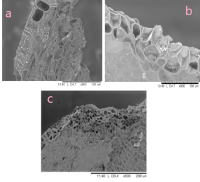
The outer layers of wheat and barley, especially the aleurone layer (AL), are mostly removed with the bran during white flour production. This study aimed to analyze and compare AL and whole grain (WG) extracts of three cereals; soft wheat (Triticum aestivum, Arz), durum wheat (Triticum durum, Ofanto), and barley (Hordeum vulgare, Rihane) to assess their secondary metabolites, including phenolic compounds, flavonoids, and condensed tannins, as well as their antioxidant activity. The structural/morphological features of the cereal species were examined using scanning electron microscopy. The total polyphenol (TP), flavonoid, (TF) and condensed tannin (CT) contents of the WG and AL of the cereal extracts were determined using colorimetric methods. The antioxidant activity was determined using 2, 2-diphenyl-picrylhydrazyl (DPPH) radical scavenging and ferric reducing antioxidant power (FRAP) assays. Among the WG extracts, ‘Rihane’ showed the highest TPC (1.788 ± 0.012 mg GAE/g), TF (0.082 ± 0.009 mg QE/g), and CT (0.03 ± 0.01 mg CE/g). In AL extracts, TPC ranged from 0.889 ± 0.012 to 1.397 ± 0.060 mg GAE/g, and TFC from 0.022 ± 0.01 to 0.030 ± 0.01 mg QE/g, with AL ‘Ofanto’ showing slightly higher values. The highest tannin content in both WG and AL was recorded for ‘Rihane’ with tannin content of 0.054 ± 0.006 mg CE/g (WG) and 0.043 ± 0.01 mg CE/g (AL). WG ‘Rihane’ had the most potent antioxidant activity (DPPH IC50 = 752 µg/mL). These findings highlight the nutritional potential of the aleurone layer as a valuable source of bioactive compounds including antioxidants.
Downloads
Article Details
Section

This work is licensed under a Creative Commons Attribution-NonCommercial-NoDerivatives 4.0 International License.
How to Cite
References
1.Liang H, Zhou J, Chen C. The Aleurone Layer of Cereal Grains: Development, Genetic Regulation, and Breeding Applications. Plant Commun. 2025; 6(4):101283. Doi:10.1016/j.xplc.2025.101283.
2.Kaur A, Purewal SS, Phimolsiripol Y, Punia-Bangar S. Unraveling the Hidden Potential of Barley (Hordeum vulgare): An Important Review. Plants. 2024; 13(17):2421. Doi:10.3390/plants13172421.
3.Tian W, Zheng Y, Wang W, Wang D, Tilley M, Zhang G, He Z, Li Y. A Comprehensive Review of Wheat Phytochemicals: From Farm to Fork and Beyond. Compr Rev Food Sci Food Saf. 2022; 21(3):2274–2308. Doi:10.1111/1541-4337.12960.
4.Niu Y, Ji C, Wang H, Hu H, Zhao R. Study on the Nutritional Value and Safety of Wheat Aleurone Layer Flour Produced by Cyclone Vortex Shear Separation Technology. J Henan Univ Technol Nat Sci Ed. 2022; 43(1):1–8. Doi:10.16433/j.1673-2383.2022.01.001.
5.Chen Z, Mense AL, Brewer LR, Shi YC. Wheat Bran Layers: Composition, Structure, Fractionation, and Potential Uses in Foods. Crit Rev Food Sci Nutr. 2023; 64(19):6636–6659. Doi:10.1080/10408398.2023.2171962.
6.Lebert L, Buche F, Sorin A, Aussenac T. The Wheat Aleurone Layer: Optimization of Its Benefits and Application to Bakery Products. Foods. 2022; 11(22):3552. Doi:103390/foods11223552.
7.Zhang L, García-Pérez P, Martinelli E, Giuberti G, Trevisan M, Lucini L. Different Fractions from Wheat Flour Provide Distinctive Phenolic Profiles and Different Bioaccessibility of Polyphenols Following In vitro Digestion. Food Chem. 2023; 404(Pt A):134540. Doi:10.1016/j.foodchem.2022.134540.
8.Shahidi F, Danielski R, Rhein SO, Meisel LA, Fuentes J, Speisky H, Schwember AR, de Camargo AC. Wheat and Rice Beyond Phenolic Acids: Genetics, Identification Database, Antioxidant Properties, and Potential Health Effects. Plants (Basel). 2022; 11(23):3283. Doi:10.3390/plants11233283.
9.Lullien-Pellerin V. Developments in Fractionation Methods to Improve Extraction of Aleurone or Its Beneficial Compounds from Wheat Grain. In: Beta T, editor. Improving the Nutritional and Nutraceutical Properties of Wheat and Other Cereals. Cambridge: Burleigh Dodds Science Publishing; 2021. ISBN: 978-1-78676-479-9.
10.Meziani S, Nadaud I, Tasleem-Tahir A, Nurit E, Benguella R, Branlard G. Wheat Aleurone Layer: A Site Enriched with Nutrients and Bioactive Molecules with Potential Nutritional Opportunities for Breeding. J Cereal Sci. 2021; 100:103225. Doi:10.1016/j.jcs.2021.103225.
11.Pavel S, Sluková M, Stýblová B, Trusová Š, Sinica A, Bleha R, Švec I, Kotrcová V. Utilization of the Nutritional Potential of Wheat Bran Using Different Fractionation Techniques. Appl Sci. 2024; 14(16):7222. Doi:10.3390/app14167222.
12.Chalamacharla RB, Harsha K, Sheik KB, Viswanatha CK. Wheat Bran Composition and Nutritional Quality: A Review. Adv Biotechnol Microbiol. 2018; 9(1):555754. Doi:10.19080/AIBM.2018.09.555754
13.Borrelli GM and Ficco DBM. Cereals and Cereal-Based Foods: Nutritional, Phytochemical Characterization and Processing Technologies. Foods. 2025; 14(7):1234. Doi:10.3390/foods14071234.
14.Horvat D, Šimić G, Drezner G, Lalić A, Ledenčan T, Tucak M, Plavšić H, Andrić L, Zdunić Z. Phenolic Acid Profiles and Antioxidant Activity of Major Cereal Crops. Antioxidants. 2020; 9(6):527. Doi:10.3390/antiox9060527.
15.Nowak R, Szczepanek M, Kobus-Cisowska J, Stuper-Szablewska K, Dziedziński M, Błaszczyk K. Profile of Phenolic Compounds and Antioxidant Activity of Organically and Conventionally Grown Black-Grain Barley Genotypes Treated with Biostimulant. PLoS One. 2023; 18(7):e0288428. Doi:10.1371/journal.pone.0288428.
16.Zhou K and Yu L. Phytochemicals and Antioxidant Properties in Wheat Bran. J Agric Food Chem. 2004; 52(20):6108–6114. Doi:10.1021/jf049214g.
17.Carvalho DO, Curto AF, Guido LF. Determination of Phenolic Content in Different Barley (Hordeum vulgare) Varieties and Corresponding Malts by Liquid Chromatography, DAD, ESI MS/MS. Antioxidants. 2015; 4(3):563–576. Doi:10.3390/antiox4030563.
18.Antonini E, Zara C, Valentini L, Gobbi P, Ninfali P, Menotta M. Novel Insights into Pericarp, Protein Body Globoids of Aleurone Layer, and Starchy Granules of Three Cereals Gained Using Atomic Force Microscopy and Environmental Scanning Electron Microscopy. Eur J Histochem. 2018; 62(1):2869. Doi:10.4081/ejh.2018.2869.
19.Laubin B, Lullien-Pellerin V, Nadaud I, Gaillard-Martinie B, Chambon C, Branlard G. Isolation of the Wheat Aleurone Layer For 2D Electrophoresis and Proteomics Analysis. J Cereal Sci. 2008; 48(3):709–714. Doi:10.1016/j.jcs.2008.03.004.
20.Meziani S, Nadaud I, Gaillard-Martinie B, Chambon C, Benali M, Branlard G. Proteomic Analysis of the Mature Kernel Aleurone Layer in Common and Durum Wheat. J Cereal Sci. 2012; 55(3):323–330. Doi:10.1016/j.jcs.2012.01.010.
21.Meziani S, Nadaud I, Gaillard-Martinie B, Chambon C, Benali M, Branlard G. Proteomic Comparison of the Aleurone Layer in Triticum aestivum and Triticum monococcum Wheat Varieties. Curr Proteomics. 2014; 11(1):71–77. Doi:10.2174/1570164611666140415224348.
22.Meziani S, Nadaud I, Gaillard-Martinie B, Chambon C, Benali M, Branlard G. Proteomic Analysis of Mature Kernel Aleurone Layer of Triticum spelta and Three Wheat-Related Species. Nutr Health. 2019; 8(1):27–35. Doi:10.30952/ns.8.1.5.
23.Zieliński H and Kozłowska H. Antioxidant Activity and Total Phenolics in Selected Cereal Grains and Their Different Morphological Fractions. J Agric Food Chem. 2000; 48(6):2008–2016. Doi:101021/jf990619o.
24.Oufnac DS. Determination of Antioxidant Capacity in Corn Germ, Wheat Germ and Wheat Bran Using Solvent and Microwave-Assisted Solvent Extraction [dissertation]. Baton Rouge: Louisiana State University and Agricultural and Mechanical College; 2006.
25.Ali-Rachedi F, Meraghni S, Touaibia N, Sabrina M. Quantitative Analysis of Phenolic Compounds of an Algerian Endemic Scabiosa atropurpurea Subsp. Maritima L. Bull R Soc Sci Liège. 2018; 87:13–21.
26.Viuda-Martos M, Mohamady MA, Fernández-López J, Elrazik KA, Omer EA, Pérez-Álvarez JA, Sendra E. In vitro Antioxidant and Antibacterial Activities of Essential Oils Obtained from Egyptian Aromatic Plants. Food Control. 2011;22(11):1715–1722.
Doi:10.1016/j.foodcont.2011.04.003.
27.Li X, Li W, Chen F, Xiao J, Liao X, Hu X, Ji J, Ma L. Guideline for Measurement of Condensed Tannin. Food Front. 2022; 4(1):533–541. Doi:10.1002/fft2.174.
28.Kirby AJ and Schmidt RJ. The Antioxidant Activity of Chinese Herbs for Eczema and of Placebo Herbs. J Ethnopharmacol. 1997; 56(2):103–108. Doi:10.1016/S0378-8741(97)01510-9.
29.Oyaizu M. Studies on Products of Browning Reaction—Antioxidative Activities of Products of Browning Reaction Prepared from Glucosamine. Jpn J Nutr Diet. 1986; 44(6):307–315. Doi:10.5264/eiyogakuzashi.44.307.
30.Brouns F, Hemery Y, Price R, Anson NM. Wheat Aleurone: Separation, Composition, Health Aspects and Potential Food Use. Crit Rev Food Sci Nutr. 2012; 52(6):553–568. Doi:10.1080/10408398.2011.589540.
31.Benguella R, Meziani S, Chenni FZ, Labga L. Comparison of the Nutritional and Antioxidant Values of the Peripheral Layers in Two Species of Wheat (Soft and Hard) Grown in Algeria. Chilean J Agric Anim Sci. 2022; 38(1):15–25. Doi:10.29393/chjaas38-2cnra70002.
32.Labga L, Meziani S, Haoud K, Tasleem-Tahir A. Isolation and Study of the Nutritional Variability of Peripheral Layers of Barley Grains During Development. Adv Res Life Sci. 2022; 6(1):1–11. Doi:10.2478/arls-2022-0032.
33.Saidani S, Zairi M, Meziani S, Labga L, Tiboura G, Menadi N, Demmouche A. Bioactive Compounds and Antioxidant Activity of Peripheral Layers of Soft Wheat Grown in Algeria During Seed Filling. Food Environ Saf J. 2022; 21(1):82–93. Doi:10.4316/fens.2022.009.
34.Ivanisova E, Ondrejovic M, Silhar S. Antioxidant Activity of Milling Fractions of Selected Cereals. Nova Biotechnol Chim. 2012; 11(1):45–54. Doi:10.2478/v10296-012-0005-0.
35.Martini D, Taddei F, Ciccoritti R, Pasquini M, Nicoletti I, Corradini D, D’Egidio MG. Variation of Total Antioxidant Activity and of Phenolic Acid, Total Phenolics and Yellow-Coloured Pigments in Durum Wheat (Triticum turgidum L. Var. durum) as a Function of Genotype, Crop Year and Growing Area. J Cereal Sci. 2015; 65:175–185. Doi:10.1016/j.jcs.2015.06.012.
36.López-Perea P, Guzmán-Ortiz FA, Román Gutiérrez AD, Castro Rosas J, Gómez Aldapa CA, Rodríguez Marín ML, Falfán Cortés RN, González Olivares LG, Torruco Uco JG. Bioactive Compounds and Antioxidant Activity of Wheat Bran and Barley Husk in Extracts with Different Polarity. Int J Food Prop. 2019; 22(1):646–658. Doi:10.1080/10942912.2019.1600543.
37.Šimić G, Lalić A, Horvat D, Viljevac Vuletić M, Dvojković K, Jukić M, Lukinac J, Abičić I. Genotypic, Environmental, and Processing Effects on Phenolic Content and Antioxidant Activity in Barley and Wheat. Plants (Basel). 2025; 14(11):1664. Doi:10.3390/plants14111664.
38.Loskutov IG and Khlestkina EK. Wheat, Barley, and Oat Breeding for Health Benefit Components in Grain. Plants (Basel). 2021; 10(1):86. Doi:10.3390/plants10010086.
39.Stuper-Szablewska K, Kurasiak-Popowska D, Nawracała J, Perkowski J. Quantitative Profile of Phenolic Acids and Antioxidant Activity of Wheat Grain Exposed to Stress. Eur Food Res Technol. 2019; 245:1595–1603. Doi:10.1007/s00217-019-03262-8.
40.Rudrapal M, Khairnar SJ, Khan J, Dukhyil AB, Ansari MA, Alomary MN, Alshabrmi FM, Palai S, Deb PK, Devi R. Dietary Polyphenols and Their Role in Oxidative Stress-Induced Human Diseases: Insights into Protective Effects, Antioxidant Potentials and Mechanism(s) of Action. Front Pharmacol. 2022; 13:806470. Doi:10.3389/fphar.2022.806470.
41.Pang Y, Li S, Yan Q, Zhang P, Lu Y, Zhao C, Li T, Zhao H, Sun S, Zhou T, Wang X, Zhu H, Li Y, Kong L, Bai G, Liu S, Wu Y. Genetic Architecture of Condensed Tannins Accumulated in Wheat Grain. Crop J. 2025; 65(5):132301.
42.Triki T, Guasmi F, Boussora F, Ben Mohamed M, Ben Ali S, Guasmi A, Yahia H, Nagaz K. Study of the Phenolic Composition and Antioxidant Properties of Extracts from the Leaves of Five Varieties of Barley (Hordeum vulgare L.) Subjected to Water Stress (PEG6000). J Arid Regions. 2018; 43(3):653–659.
43.Falleh H, Ksouri R, Chaieb K. Phenolic Composition of Cynara cardunculus L. Organs and Their Biological Activities. C R Biol. 2008; 331(5):372–379. Doi:10.1016/j.crvi.2008.02.008.
44.Ajani R, Oboh G, Adefegha SA, Akindahunsi AA. Free Polyphenol Contents, Antioxidant Activity and Inhibition of Enzymes Linked with Type 2 Diabetes of Bread Produced from Cocoa Powder Flavoured Improved Variety Cassava–Wheat Composite Flours. Trop J Nat Prod Res. 2022; 6(2):227–235.
45.Liu J, Yu L, Wu Y. Bioactive components and health beneficial properties of whole wheat foods. J Agric Food Chem. 2020; 68(22):6029-6043. doi:10.1021/acs.jafc.0c00705.
46.Yang T, Tian S, Chen Y, Lu J, Niu Y. Analysis of nutritional components in the bran of debranned wheat and comparison with endosperm flour. BioResources. 2025; 20(1):1384-1398.
47.Dall’Asta M, Bresciani L, Calani L, Cossu M, Martini D, Melegari C, Del Rio D, Pellegrini N, Brighenti F, Scazzina F. In vitro Bioaccessibility of Phenolic Acids from a Commercial Aleurone-Enriched Bread Compared to a Whole Grain Bread. Nutrients. 2016; 8(1):42. Doi:10.3390/nu8010042.
48.Luo D, Ma J, Sang Z, Xie Q, Chen C, Wang J, Xue W. Optimization of Separation Parameters of Wheat Aleurone Layer Flour and Their Influence on Characteristics of Wheat Flour and Dough. Food Sci. 2024; 45(11):217–225. Doi:10.7506/spkx1002-6630-20230614-122.
49.Ragaee S, Guzar I, Abdel-Aal E-SM, Seetharaman K. Bioactive Components and Antioxidant Capacity of Ontario Hard and Soft Wheat Varieties. Can J Plant Sci. 2012; 92(1):19–30. Doi:10.4141/cjps2011-100.
50.Holtekjølen AK, Sahlstrøm S, Knutsen SH. Phenolic Contents and Antioxidant Activities in Covered Whole-Grain Flours of Norwegian Barley Varieties and in Fractions Obtained After Pearling. Acta Agric Scand B. 2011; 61(1):67–74. Doi:10.1080/09064710903496527.
51.Escande, F, Porchet, N, Aubert JP. Batra SK. Structural organization and classification of the human mucin genes. Frontiers in Bioscience. 2001; 6, D1192–1206.
52.Colombel JF, Aboubakr A, Narula N. Systematic review: Safety of mesalazine in ulcerative colitis. Aliment. Pharmacol. Ther. 2018; 47:1597–1609. doi: 10.1111/apt.14688.