


N-Methyl-N-Nitroso-Urea Induced-DNA Damage Response in the Breast Tissues of Female Albino Rats Treated with Ethanol Extract of Solanum erianthum D. Don
Article Sidebar
Views | PDF/EPUB Downloads:
60
/ 29
/ 24
Main Article Content
Abstract
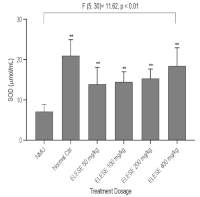
Solanum erianthum has been traditionally recognized for its anti-inflammatory and anticancer properties; however, the mechanism by which its ethanol leaf extract (ELESE) mitigates N-methyl-N-nitroso-urea (NMU)-induced breast tissue damage remains unclear. This study evaluated the tumor-suppressive and antioxidant potential of ELESE on NMU-induced mammary gland tumors in female albino rats. A total of thirty (30) adult female albino rats were sectioned into six groups which comprises: control, NMU-group, ELESE-50 mg/kg, ELESE-100 mg/kg, ELESE-200 mg/kg, ELESE-400 mg/kg. 50 mg/kg of the NMU was administered via the buccal cavity to groups except the control, while ELESE was concomitantly administered to each group with the use of a cannula for 30 days and the following parameters got evaluated: Glutathione (GSH) increased significantly (p<0.01) in ELESE-200mg/kg and ELESE-400 mg/kg compared to NMU group. Superoxide dismutase (SOD) significant (p<0.01) in ELESE-100, 200, 400 and 50 mg/kg respectively compared to the NMU-group. Catalase (CAT) level insignificant (p<0.05) in ELESE-200 mg/kg, 50 mg/kg, and 100 mg/kg in comparison with the NMU group, significant (p<0.01) in ELESE-400 mg/kg. Malondialdehyde (MDA) level reduced significantly (p<0.01) in ELESE-50 mg/kg and 400 mg/kg. Hemoglobin (Hgb) levels in ELESE-groups reduced significantly (p<0.01) in 400mg/kg compared to NMU-group. Hematocrit (HCT) level in the ELESE 50 mg/kg group surge significantly (p<0.1) compared to the NMU-group. γH2AX molecular marker was used to study DNA damage. The tail DNA percentage reduced in ELESE-400 mg/kg and 50 mg/kg compared to the NMU-group, demonstrating a protective effect against genotoxicity and indicating antioxidant effect. ELESE may ameliorate nitroso-methyl- urea (NMU)induced breast tissue damage
Downloads
Article Details
Section

This work is licensed under a Creative Commons Attribution-NonCommercial-NoDerivatives 4.0 International License.
How to Cite
References
1.Uzoekwe NM, Ejidike IP, Ehijele Ukhun M. Toxicological Assessment of Solanum Erianthum Extracts in Albino Rats: Haematological, Biochemical and Histopathological Findings. Iranian J of Toxi. 2021;15(1):37-48.
2.Badiora, Adeleke. "Protective effects of Solanum erianthum D. Don leaf extract on lead-induced toxicity in adult Wistar rats." J of App Pharm. Sci. (2016).
3.Chidambaram K, Alqahtani T, Alghazwani Y, Aldahish A, Annadurai S, Venkatesan K, Dhandapani K, Thilagam E, Venkatesan K, Paulsamy P, Vasudevan R. Medicinal Plants of Solanum Species: The Promising Sources of Phyto‐Insecticidal Compounds. J of Trop Med. 2022(1),4952221.
4.Ajaib, Muhammad, Sairah Hafeez Kamran, Muhammad Faheem Siddiqui, Muhammad Qasim, Muhammad Azeem, Zainul Abideen, Attiat Elnaggar, and Ali El-Keblawy. "Exploring the phytochemical, antioxidant, antimicrobial and analgesic potentials of Solanum erianthum as an alternative biological feedstock for producing sustainable biochemicals." Bio-cata and Agric. Biotech. 58 (2024): 103183.
5.Rahman S, Husen A. Antimalarial Response, Traditional and Other Potential Uses of Solanum Genus. In Anti. Med. Plants 2024;22 (pp. 259-269). CRC Press.
6.Ejidike IP. Toxicological Assessment of Solanum Erianthum Extracts in Albino Rats: Haematological, Biochemical and Histopathological Findings.Uzoekwe NM, Ejidike IP, Ukhun ME. Toxicological assessment of Solanum erianthum extracts in albino rats: haematological, biochemical and histopathological findings. Iran J Toxicol. 2021;15(1):37-48.
7.Okeke U, Minari JB, Okpuzor J. Chemo-preventive activity of ethanolic extracts of Newbouldia laevis and Olax subscorpioidea leaves on methylnitrosourea–induced stroma fibrosis in breast tissues of female albino rats. J Appl Sci Environ Manage. 2023;31(1):115-23.
8.Zahid MI, Ramzan H, Mustafa G, Shakoori FR, Bhat TA. Mutations and Mechanisms. Molecular Genetics, Structures, Mechanisms, and Functions: Volume 1: Prin. of Gene Mani. and Geno. 2025; 30:185.
9.Diab KA, Fahmy MA, Hassan EM, El-Toumy SA. Evaluation of the cytotoxic, anticancer, and genotoxic activities of Acacia nilotica flowers and their effects on N-methyl-N-nitrosourea-induced genotoxicity in mice. Mol. Bio. Reports. 2022;49(9):8439-48.
10.Sholaja, O.B., Okeke, U., AYOKHAI, J. and Ojo, S. Expression of cdk4 Gene in NMU-Induced Breast Cancer Wister Female Albino Rats Treated with Ethanolic Extract of Peperomia pellucida Aerial Parts: Anti-Hyperplasia Property of The Peperomia Pellucida Aerial Parts Extract In N-Methyl-N-Nitrosourea Induced Breast Cancer of Wister Female Albino Rat. Adv. in Techn., 2023 pp.40-50.
11.Jiang N, Naz S, Ma Y, Ullah Q, Khan MZ, Wang J, Lu X, Luosang DZ, Tabassum S, Chatha AM, Basang WD. An overview of comet assay application for detecting DNA damage in aquatic animals. Agriculture. 2023;13(3): 623.
12.Santos CL, Pourrut B, Ferreira de Oliveira JM. The use of comet assay in plant toxicology: recent advances. Front Genet. 2015 Jun 30; 6:216. doi: 10.3389/fgene.2015.00216. PMID: 26175750; PMCID: PMC4485349.
13.Lu Y, Liu Y, Yang C. Evaluating in vitro DNA damage using comet assay. J Vis Exp (JoVE). 2017;(128):56450.
14.Li J, Jia Z, Dong L, Cao H, Huang Y, Xu H, et al. DNA damage response in breast cancer and its significant role in guiding novel precise therapies. Biomark Res. 2024;12(1):111.
15.Bray F, Laversanne M, Sung H, Ferlay J, Siegel RL, Soerjomataram I, et al. Global cancer statistics 2022: GLOBOCAN estimates of incidence and mortality worldwide for 36 cancers in 185 countries. CA Cancer J Clin. 2024; 3:229-63.
16.McGrail DJ, Li Y, Smith RS, Feng B, Dai H, Hu L. Widespread BRCA1/2-independent homologous recombination defects are caused by alterations in RNA-binding proteins. Cell Rep Med. 2023;4(11).
17.Li Q, Qian W, Zhang Y, Hu L, Chen S, Xia Y. A new wave of innovations within the DNA damage response. Signal Transduct Target Ther. 2023;8(1):338.
18.Sharma S, Kumar C, Kushwaha H, Jha SK, Chawla S, Sharma A, Midha T, Huddar V. Advancing anticancer drug development: Overcoming challenges and exploring new therapeutic strategies. Ay. J. of Int. Onco.. 2025;1;2(1):8-27.
19.Babalola O, Agbi J, Badiora A, Areola O. Protective effects of Solanum erianthum D. Don leaf extract on lead-induced toxicity in adult Wistar rats. J Appl Pharm Sci. 2016;6(10):113-23.
20.Magnang H, Kueviakoé MDI, Togbenou K, Agbonon A, Effect of Hydromethanolic Extract of Stem Bark of Lannea kerstingii on Anemia and Hepcidin Production, J Drug Delivery Therap. 2023; 13(2):70-74.
21.Oyewale MR, Osundahunsi OF, Awolu OO. Modulatory effect of Justicia secunda leaf extract on hematological status, lipid profile, liver function and oxidative stress in Wistar rats. Advance in Trad. Med. 2024;24(2):531-40.
22.Hadwan MH, Kadhum Ali S. New spectrophotometric assay for assessments of catalase activity in biological samples. Anal Biochem. 2018; 542:29-33.
23.Aletan UI, Onifade OO, Yisa AG, Idowu AO, Samuel SA, Osegbo AN, Omada S. Changes in oxidative stress biomarkers in Wistar albino rats due to the oral administration of aqueous stem extract of Cissus populnea (Okoho). Dutse J. of Pure and Appl. Sci. 2024;10(3b):282-91.
24.Rizzo M. Measurement of malondialdehyde as a biomarker of lipid oxidation in fish. American Journal of Analytical Chemistry. 2024;11;15(9):303-32.
25.Adefisan AO, Owumi SE, Soetan KO, Adaramoye OA. Chloroform extract of Calliandra portoricensis inhibits tumourigenic effect of N-methyl-N-nitrosourea and benzo(a)pyrene in breast experimental cancer. Drug Chem Toxicol. 2022 Nov;45(6):2424-2438. doi: 10.1080/01480545.2021.1957556. Epub 2021. PMID: 34325589.
26.Mostafa MD, Amer ME, ElKomy MA, Othman AI, ElMissiry MA. Thymoquinone controlled obesity and invigorated cognitive and memory performance in rats consuming a high-fat diet via modulating oxidative stress, inflammation and apoptosis. Scientific Reports. 2025;15(1):20171.
27.Campbell NJ, Barton C, Cutress RI, Copson ER. Impact of obesity, lifestyle factors and health interventions on breast cancer survivors. Proceedings of the Nutri. Soci. 2023;82(1):47-57.
28.Verma S, Bahorun T, Singh RK, Aruoma OI, Kumar A. Effect of Aegle marmelos leaf extract on N-methyl N-nitrosourea-induced hepatocarcinogensis in Balb/c mice. Pharmaceu. Bio. 2013;51(10):1272-81.
29.Ali LO. Study effect of breast cancer on some hematological and biochemical parameters in Babylon Province, Iraq. J Pharm Biol Sci. 2014; 3:20-4.
30.Ko SM, Lee J, Bae SJ, Baik SJ, Ji J, Kim D, Ahn SG, Jeong J. Body mass index and absolute lymphocyte count predict disease-free survival in Korean breast cancer patients. British J of cancer. 2021;125(1):119-25.
31.Park B, Lee HS, Lee JW, Park S. Association of white blood cell count with breast cancer burden varies according to menopausal status, body mass index, and hormone receptor status: a case-control study. Sci Rep. 2019;9(1):5762.
32.Georgiou-Siafis SK, Tsiftsoglou AS. The key role of GSH in keeping the redox balance in mammalian cells: mechanisms and significance of GSH in detoxification via formation of conjugates. Antioxidants. 2023;12(11):1953.
33.Engwa GA, Nweke FN, Nkeh-Chungag BN. Free radicals, oxidative stress-related diseases and antioxidant supplementation. Alternative Therapies in Health & Medicine. 2022;28(1).
34.Chen Y, Yu D, Zhu D, Muthusamy S, Deshpande M, Kiruthiga N, Theivendren P, Rajalakshmi K, Wu S, Zhu C. Exploring Alkaloids and Flavonoids from Natural Sources: Emerging Natural Agents for Inhibiting Cervical cancer Progression through Apoptosis Induction, Anti-Inflammatory Effects, and Oxidative Stress Reduction. Pathology-Research and Practice. 2025:156092.
35.Farooq U, Sharma A, Khajuria V, Nabi B, Mahajan D. Effect of repeated oral administration of butachlor and lead alone and in combination on oxidative stress and histopathology in Wistar rats. Pharma Innov J. 2022; 11:428-34.
36.Roy Z, Bansal R, Siddiqui L, Chaudhary N. Understanding the role of free radicals and antioxidant enzymes in human diseases. Curr Pharm Biotechnol. 2023;24(10):1265-76.
37.Singh A, Upadhyay A, Singh J, Singh AK, Gautam DN, Singh NK. Ayurvedic strategy to achieve Sustainable Development Goal 3: management of cancer (Arbuda). Strategies to achieve Sustainable Development Goals (SDGs). Nova Sci Pub. 2022:141-66.
38.Cordiano R, Di Gioacchino M, Mangifesta R, Panzera C, Gangemi S, Minciullo PL. Malondialdehyde as a potential oxidative stress marker for allergy-oriented diseases: an update. Molecules. 20239;28(16):5979.
39.Alawode TT, Lajide L, Owolabi BJ, Olaleye MT, Ilesanmi OB. Phytochemical investigation, in vitro antioxidant and anti-inflammatory evaluation of leaf extracts of Solanum erianthum. Curr J Appl Sci Technol. 2017;24(5):1-1.
40.Beytur A, Tekin Ç, Çalışkan E, Tekin S, Koran K, Görgülü AO, Sandal S. Hexa-substituted cyclotriphosphazene derivatives containing hetero-ring chalcones: Synthesis, in vitro cytotoxic activity and their DNA damage determination. Bioorganic Chemistry. 2022; 127:105997.
41.Senizza B, Rocchetti G, Sinan KI, Zengin G, Mahomoodally MF, Glamocilja J, Sokovic M, Lobine D, Etienne OK, Lucini L. The phenolic and alkaloid profiles of Solanum erianthum and Solanum torvum modulated their biological properties. Food Biosci. 2021; 41:100974.
42.Winkiel MJ, Chowański S, Słocińska M. Anticancer activity of glycoalkaloids from Solanum plants: A review. Front Pharmacol. 2022; 13:979451.