


New Data on the Production of Natural Honey in Morocco: Practices of Beekeepers, Melliferous Plants, and Production Features
Article Sidebar
Views | PDF/EPUB Downloads:
69
/ 38
/ 23
Main Article Content
Abstract
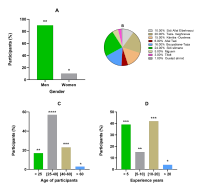
Despite the importance of honey production in food, medicine, and the economy of Morocco, the data on practices, productivity, and melliferous plants are rare and fragmentary. Therefore, this study evaluated the age, gender, and practices of beekeepers from Fez-Meknes, Daraa-Tafilalet, Rabat-Sale-Kenitra, and Tangier-Tetouan-Al Hoceima. Honey production addressed the used plants, quality, quantity, and limiting factors. Data was collected via questionnaire and analyzed with descriptive and multivariate statistics. In total, 100 beekeepers were included, with a dominance of men (90%) aged between 25 and 50 years. 60% of beekeepers used modern hives. Apis mellifera intermissa was the most common (65%). Most participants (74%) practice transhumance, and 45% of beekeepers are transhumant. In total, 10 melliferous plants were recorded, and the most popular were jujube (14%), carob (13%), and eucalyptus (12%). These plants flower in spring, summer, and autumn. Varroa presented the largest menace to bee health (44%), followed by hornets (16%), nosema (15%), moths (14%), and loque (12%). To protect their beehives, participants use different treatments, including fumigation with local medicinal plants (37%), followed by thymol (21%). This study revealed new data on the beekeepers, production, and practices in different areas of Morocco and is suggested to serve as a reference for future studies and for conservation efforts, mainly for bee and plant species.
Downloads
Article Details
Section

This work is licensed under a Creative Commons Attribution-NonCommercial-NoDerivatives 4.0 International License.
How to Cite
References
1. Topal E, Adamchuk L, Negri I, Kösoğlu M, Papa G, Dârjan MS, Cornea-Cipcigan M, Mărgăoan R. Traces of Honeybees, Api-Tourism and Beekeeping: From Past to Present. Sustainability. 2021;13(21):11659; doi: 10.3390/su132111659.
2. Harianja AH, Adalina Y, Pasaribu G, Winarni I, Maharani R, Fernandes A, Saragih GS, Fauzi R, Tampubolon AP, Njurumana GN, Sukito A. Potential of Beekeeping to Support the Livelihood, Economy, Society, and Environment of Indonesia. Forests. 2023;14(2):321; doi: 10.3390/f14020321.
3. Ouattara S, Assi-Kaudjhis C, Adjonou K, Kouamé KF, Koudegnan CM, Kokou K. State of Knowledge on Beekeeping Practices in Côte d’Ivoire in the Face of Challenges and Opportunities in the Context of Climate Change. ESI Prepr. 2023;19(30):46–46; doi: https://doi.org/10.19044/esj.2023.v19n30p46.
4. Ahouandjinou STB, Yédomonhan H, Tossou GM, Adomou AC, Akoègninou A. Diversity of honey plants in the Sudanian zone: the case of the classified forest of the Kouandé hills, Northwest Benin. Afr Sci. 2017;13(6):149–163.
5. Awazi NP, Avana-Tientcheu ML, Alemagi D, Abanda FH, Enongene K, Nfornkah BN, Fobissie K. Nature-Based Solutions for Climate Change Adaptation and Mitigation in Cameroon: Realities and Perspectives. In: Handbook of Nature-Based Solutions to Mitigation and Adaptation to Climate Change Springer, Cham; 2024; pp. 1–44; doi: 10.1007/978-3-030-98067-2_77-1.
6. Aguilar A, Wohlgemuth R, Twardowski T. Perspectives on bioeconomy. New Biotechnol. 2018;40:181–184; doi: 10.1016/j.nbt.2017.06.012.
7. Albrecht M, Grundel I, Morales D. Regional bioeconomies: public finance and sustainable policy narratives. Geogr Ann Ser B Hum Geogr. 2021;103(2):116–132; doi: 10.1080/04353684.2021.1921603.
8. Moujanni A, Essamadi AK, Terrab Benjelloun A. Beekeeping in Morocco: a focus on honey production. Int J Innov Appl Stud. 2017;20(1):52-78.
3. MAPM. Program Contracts for the Development of Production Sectors. Rabat (Morocco): Ministry of Agriculture, Maritime Fisheries, Rural Development and Water and Forests, Department of Agriculture; 2015; p. 15; http://www.agriculture.gov.ma/sites/default/files/contrats_programmes_vf.pdf.
10. Stührenberg L. Green Morocco Plan: the main principles and progress of the Moroccan agricultural strategy. Bull Synthèse Souveraineté Aliment. 2016;20.
11. Simenel R, Adam A, Crousilles A, Amzil L, Aumeeruddy-Thomas Y. The domestication of the bee through territory. Tech Cult Rev Semest D’anthropologie Tech. 2015;(63):258–279; doi: 10.4000/tc.7516.
12. Lekbir AB, Yous FZ, Ouhammou A, Alifriqui M. Diversity and characteristics of the flora of Moroccan Macaronesia (Territory of Sidi Ifni). Mediterr Bot. 2024;45(1):10; doi: https://doi.org/10.5209/mbot.82370.
13. Ailli A, Zibouh K, Eddamsyry B, Drioiche A, Fetjah D, Ayyad FZ, Mothana RA, Hawwal MF, Radi M, Tarik R, Elomri A. Physicochemical Characterization of Moroccan Honey Varieties from the Fez-Meknes Region and Their Antioxidant and Antibacterial Properties. Metabolites. 2024;14(7):364; doi: 10.3390/metabo14070364.
14. Sahri N, Alaoui A, Elherradi E, Mahmoud MF, Louaradi D, Sobeh M. Euphorbia honey: a comprehensive compile of its traditional use, quality parameters, authenticity, adulteration, and therapeutic merits. Phytochem Rev. 2024;23(3):721–748; doi: 10.1007/s11101-023-09905-9.
15. Ouradi H, Hanine H, Fauconnier M-L, Kenne T, Rizki H, Ennahli S, Hssaini L. Comparative study on the physicochemical characteristics and botanical diversity of Moroccan honeys. Euro-Mediterr J Environ Integr. 2025;10(3):1711–1723; doi: 10.1007/s41207-024-00602-3.
16. Ouradi H, Hanine H, Fauconnier M-L, Kenne T, Rizki H, Ennahli S, Hssaini L. Determination of physico-biochemical proprieties and composition in volatile constituents by solid phase micro-extraction of honey samples from different botanical and geographical origins in Morocco. J Apic Res. 2021;60(1):84–98; doi: 10.1080/00218839.2020.1718339.
17. Aazza S, Lyoussi B, Antunes D, Miguel MG. Physicochemical characterization and antioxidant activity of 17 commercial Moroccan honeys. Int J Food Sci Nutr. 2014;65(4):449–457; doi: 10.3109/09637486.2013.873888.
18. Petretto GL, Tuberoso CIG, Fenu MA, Rourke JP, Belhaj O, Pintore G. Antioxidant activity, color chromaticity coordinates, and chemical characterization of monofloral honeys from Morocco. Int J Food Prop. 2017;20(9):2016–2027; doi: 10.1080/10942912.2016.1230745.
19. Bakhchou S, Odoux J-F. Beekeeping professional organizations in the Fes-Meknes region of Morocco. Cah Agric/ 2020;29:12.
20. Gupta RK, Reybroeck W, van Veen JW, Gupta A. Beekeeping for poverty alleviation and livelihood security. 2014.
21. Ministry of Agriculture. Beekeeping Sector. Ministry of Agriculture, Maritime Fisheries, Rural Development and Water and Forests. 2019. Available from: https://www.agriculture.gov.ma/fr/filiere/avicole [Last accessed: 6/16/2024].
22. Bakour M, Laaroussi H, El menyiy N, Elaraj T, El ghouizi A, Lyoussi B. The Beekeeping State and Inventory of Mellifero-Medicinal Plants in the North-Central of Morocco. Sci World J. 2021;2021(1):9039726; doi: 10.1155/2021/9039726.
23. Bertrand B. Biodiversity beehives. Éditions de Terran; 2015.
24. Akunne CE, Akpan AU, Ononye BU. A checklist of nectariferous and polleniferous plants of african honeybees (Apis mellifera adansonii L.) in Awka, Nigeria. J Apic. 2016;31(4):379–387.
25. Kumar R, Rajput GS, Mishra RC, Agrawal OP. A study on assessment of duration of dearth period for Honey bees in Haryana, India. Munis Entomol Zool. 2013;8(1):434–437.
26. Rodionov VV. The Fascinating World of Bees. Mir Publishers; 1986.
27. Calderón R, Doorn M, Verde M, Vallejos L, Olate V, Van Veen JW, Sánchez A, Pérez L, Cortese M. Factors leading to the loss of honeybee health (Apis mellifera L.) in managed colonies from Latin America Latin America: A holistic approach. 2023.
28. Naudi S. Factors affecting beekeeping sustainability: pathogen spread, diagnostics and queen breeding. 2025.
29. Landaverde R, Rodriguez MT, Parrella JA. Honey Production and Climate Change: Beekeepers’ Perceptions, Farm Adaptation Strategies, and Information Needs. Insects. 2023;14(6):493; doi: 10.3390/insects14060493.
30. Tanuğur Samanci AE, Bayar Muluk N, Samanci T, Cingi C. Hives. In: Tanuğur Samanci AE, Bayar Muluk N, Samanci T, Cingi C, editors. Hives. In: Propolis: Prevention and Healing Effects in Otorhinolaryngology. (Tanuğur Samanci AE, Bayar Muluk N, Samanci T, et al. eds) Springer Nature Switzerland: Cham; 2024; pp. 13–19; doi: 10.1007/978-3-031-68546-0_3.
31. Del Signore K. Inclusive beekeeping: investigating the barriers the slow women’s participation on apiculture development in Kenya. Cornell University. 2022.
32. Bava R, Castagna F, Ruga S, Nucera S, Caminiti R, Serra M, Bulotta RM, Lupia C, Marrelli M, Conforti F, Statti G, Domenico B, Palma E. Plants and Their Derivatives as Promising Therapeutics for Sustainable Control of Honeybee (Apis mellifera) Pathogens. Pathogens. 2023;12(10):1260; doi: 10.3390/pathogens12101260.
33. Khabbach A, Libiad M, Ennabili A. Melliferous flora and apiculture in the pre-Rif of the province of Taza (North of Morocco). Luna Azul. 2013;(36):78–90.
34. Maderson S, Wynne-Jones S. Beekeepers’ knowledges and participation in pollinator conservation policy. J Rural Stud. 2016;45:88–98.
35. Abdellatif T, Anass B. Beekeeping in Moroccan rural areas: valorization of a local product through integrated filter analysis and group focus":(case of Oueltana amont, province of Azilal). J Adv Res Soc Sci Humanit ISSN. 2208-2387 2024;10(9):16–24.
36. Haddad N. Beekeeping in Algeria: evaluation of beekeeping practices, trends of management, and challenges. Afr J Food Agric Nutr Dev. 2025;25(1).
37. Hitouche S, Messak MR, Imane A, Lazereg M. Challenges of Beekeeping in Arid Regions. Socioecon Chall. 2024;8(4):191–204.
38. Ogaba MR, Akongo T. Gender Issues in Beekeeping–The Uganda Case. In: APIMONDIA Congress. Durban, South Africa. 2001.
39. Chafik S. Plan Bee: The Case of an Islamic Honey Cooperative in Morocco. Halduskultuur. 2023;XXII(1):4–26.
40. Bhujel P, Wangchuk T, Choki S, Gurung K, Raika V, Wangchuk S. Honey yield evaluation from the traditional and modern moveable frame hives. Bhutan J Anim Sci. 2022;6(1):28–33.
41. Tarekegn K, Ayele A. Impact of improved beehives technology adoption on honey production efficiency: empirical evidence from Southern Ethiopia. Agric Food Secur. 2020;9(1):7; doi: 10.1186/s40066-020-00258-6.
42. Ainembabazi JH, Mugisha J. The Role of Farming Experience on the Adoption of Agricultural Technologies: Evidence from Smallholder Farmers in Uganda. J Dev Stud. 2014;50(5):666–679; doi: 10.1080/00220388.2013.874556.
43. Bekuma A. Review on adoption of modern beehive technology and determinant factors in Ethiopia. J Nat Sci Res. 2018;8(3):26–29.
44. Kiprono N, Lagat J, Gitau R. Determinant Factors Affecting the Uptake of Modern Beehives. Int J Sci Res. 2021; 2319-7064.
45. Ruttner F, Tassencourt L, Louveaux J. Biometrical-statistical analysis of the geographic variability of Apis mellifera LI Material and methods. Apidologie. 1978;9(4):363–381.
46. Ruttner F. Biogeography and Taxonomy of Honeybees. Springer Science & Business Media; 2013.
47. Legesse G, Getu E. Geographical and population diversity of African honeybees, Apis mellifera L.(Hymenoptera: Apidae): A review. SINET Ethiop J Sci. 2022;45(2):235–248.
48. Chontal GL, Peña JGR, Echeverría EF, Mendoza EM, Zorrilla UAD, Lambert GF. A critical point in beekeeping: beekeepers’ health. 2019.
49. Chontal GL, Peña JGR, Echeverría EF, Mendoza EM, Zorrilla UAD, Lambert GF. Bee characterization in the sierra central-north region of Veracruz: context and transhumance. Rev Mex Cienc Agríc Vol. 2019;10(6).
50. Bellarby J, Foereid B, Hastings AFSJ, Smith P. Cool Farming: Climate impacts of agriculture and mitigation potential. Greenpeace International. 2008.
51. Campos MGR, Bogdanov S, De Almeida-Muradian LB, Szczesna T, Mancebo Y, Frigerio C, Ferreira F. Pollen composition and standardisation of analytical methods. J Apic Res. 2008;47(2):154–161; doi: 10.1080/00218839.2008.11101443.
52. Terrab A, Valdés B, Díez MJ. Study of plants visited by honeybees (Apis mellifera L.) in the Central Rif Region (N. Morocco) using pollen analysis. Grana. 2005;44(3):209–215; doi: 10.1080/00173130500219783.
53. Touzani S, Al-Waili N, El Menyiy N, Filipic B, Pereyra A, Arabi IE, Al-Waili W, Lyoussi B. Chemical analysis and antioxidant content of various propolis samples collected from different regions and their impact on antimicrobial activities. Asian Pac J Trop Med. 2018;11(7):436–442.
54. Le Conte Y, Ellis M, Ritter W. Varroa mites and honey bee health: can Varroa explain part of the colony losses? Apidologie. 2010;41(3):353–363.
55. Ramsey SD, Ochoa R, Bauchan G, Gulbronson C, Mowery JD, Cohen A, Lim D, Joklik J, Cicero JM, Ellis JD, Hawthorne D, vanEngelsdorp D. Varroa destructor feeds primarily on honey bee fat body tissue and not hemolymph. Proc Natl Acad Sci. 2019;116(5):1792–1801; doi: 10.1073/pnas.1818371116.
56. Bowen‐Walker PL, Gunn A. The effect of the ectoparasitic mite, Varroa destructor on adult worker honeybee ( Apis mellifera ) emergence weights, water, protein, carbohydrate, and lipid levels. Entomol Exp Appl. 2001;101(3):207–217; doi: 10.1046/j.1570-7458.2001.00905.x.
57. Yang X, Cox-Foster DL. Impact of an ectoparasite on the immunity and pathology of an invertebrate: Evidence for host immunosuppression and viral amplification. Proc Natl Acad Sci. 2005;102(21):7470–7475; doi: 10.1073/pnas.0501860102.
58. Amdam GV, Hartfelder K, Norberg K, Hagen A, Omholt SW. Altered physiology in worker honey bees (Hymenoptera: Apidae) infested with the mite Varroa destructor (Acari: Varroidae): a factor in colony loss during overwintering? J Econ Entomol. 2004;97(3):741–747; doi: https://doi.org/10.1093/jee/97.3.741.
59. Galajda R, Valenčáková A, Sučik M, Kandráčová P. Nosema disease of European honey bees. J Fungi. 2021;7(9):714.
60. Glaiim MK. Hunting behavior of the oriental hornet, Vespa orientalis L., and defense behavior of the honey bee, Apis mellifera L., in Iraq. Bull Iraq Nat Hist Mus. 2009;10(4):17–30.
61. Ishay J. Contributions to the bionomics of the Oriental hornet Vespa orientalis F. Isr J Entomol. 1967;45–106.
62. Haddad N, Fuchs S, Batainha A. Decrease of Flight Activity Caused by Vespa Orientalis at the Flight Entrance of Apis Mellifera Syriaca in Jordan. In: Proc. 2nd. Europ. Conf. of Apidology EurBee, Prague (Czech Rep.). 2006; p. 77.
63. Gomaa AM, Abd El-Wahab TE. Seasonal abundance and the efficiency of yeast liquid culture (Candida tropicalis) as bait for capturing the oriental wasps (Vespa orientalis L.) under Egyptian environment. J Appl Sci Res. 2006;2(11):1042–1046.
64. Branco MR, Kidd NA, Pickard RS. Development of Varroa jacobsoni in colonies of Apis mellifera iberica in a Mediterranean climate. Apidologie. 1999;30(6):491–503.
65. Schödl I, Odemer R, Becher MA, Berg S, Otten C, Grimm V, Groeneveld J. Simulation of Varroa mite control in honey bee colonies without synthetic acaricides: Demonstration of Good Beekeeping Practice for Germany in the BEEHAVE model. Ecol Evol. 2022;12(11):e9456; doi: 10.1002/ece3.9456.
66. De Guzman LI, Rinderer TE, Delatte GT, Macchiavelli RE. Varroa jacobsoni Oudemans tolerance in selected stocks of Apis mellifera L. Apidologie. 1996;27(4):193–210.
67. Ghomari FN, Kouache B, Arous A, Cherchali S. Effet de traitement par fumigation du thym (Thymus vulgaris) sur le Varroa destructor agent de la varroase des abeilles. Nat Technol Technol. 2014;(10).
68. Chekikene Imen ABD. Treatment of varroa destructor by Thymus fontanesii L by fumigation. Université de khemis-miliana. 2019.
69. Shahrouzi R. Varroosis in Iran. Abeilles Cie. 2004;103:24–25.
70. Voidarou C, Rozos G, Alexopoulos A, Plessas S, Mantzourani I, Stavropoulou E, Tzora A, Bezirtzoglou E. In vitro screening potential antibacterial properties of the Greek oregano honey against clinical isolates of Helicobacter pylori. Foods. 2021;10(7):1568.
71. Proaño A, Coello D, Villacrés-Granda I, Ballesteros I, Debut A, Vizuete K, Brenciani A, Álvarez-Suarez JM. The osmotic action of sugar combined with hydrogen peroxide and bee-derived antibacterial peptide Defensin-1 is crucial for the antibiofilm activity of eucalyptus honey. LWT. 2021;136:110379.
72. Jerković I, Kuś PM. Terpenes in honey: Occurrence, origin and their role as chemical biomarkers. RSC Adv. 2014;4(60):31710–31728.