


Isolation and Identification of Indigenous Lactic Acid Bacteria from Fermented Cabbage (Brassica oleracea L.) with Probiotic Potential
Article Sidebar
Views | PDF/EPUB Downloads:
103
/ 50
/ 38
Main Article Content
Abstract
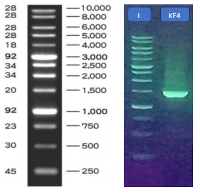
Cabbage (Brassica oleracea L.) is a widely consumed leafy vegetable with high nutritional value. Cabbage is often processed into fermented foods. Lactic acid bacteria (LAB) grow naturally on fermented cabbage, and are generally recognized as safe (GRAS) microorganisms for consumption, and have probiotic potential. This study aimed to isolate and identify indigenous LAB from fermented cabbage which have probiotic potential. Cabbage was fermented in 3% sodium chloride solution at 37°C for 9 days. Selective isolation of LAB from the fermented cabbage was performed using de Man Rogosa Sharpe (MRS) Agar. The morphological identification of LAB isolates was done macroscopically, microscopically, and biochemically. Antibacterial activity evaluation against pathogenic bacteria was performed using the agar well diffusion method. The resistance of LAB isolates to acidic conditions and bile salt were also tested. Molecular identification was done using the Polymerase Chain Reaction (PCR) technique. A pair of primers 27F and 1492R were used to amplify the 16S rRNA gene and then sequenced. The sequencing results were aligned using the BLAST program. Five LAB isolates (KF 1 – KF5) were isolated and identified from fermented cabbage. The antibacterial activity test results showed that isolate KF4 had the highest antibacterial activity against Escherichia coli, Bacillus cereus, Salmonella typhimurium, and Staphylococcus aureus. KF4 was able to grow at pH 2, and was tolerant to bile salt. BLAST analysis results showed that isolate KF4 has 99.24% similarity to Lactiplantibacillus plantarum. The findings from this study highlight the probiotic potential of the lactic acid bacteria Lactiplantibacillus plantarum, that warrant further investigation.
Downloads
Article Details
Section

This work is licensed under a Creative Commons Attribution-NonCommercial-NoDerivatives 4.0 International License.
How to Cite
References
1.Saragoça A, Canha H, Varanda,CMR, Materatsk P, Cordeiro AI, Gama J. Lactic acid bacteria: A sustainable solution against phytopathogenic agents. Environ Microbiol Rep (Wiley). 2024; 6(16):1-13. DOI: 10.1111/1758-2229.70021
2.Anjana and Santosh KT. Bacteriocin-Producing Probiotic Lactic Acid Bacteria in Controlling Dysbiosis of the Gut Microbiota. Front Cell Infect Microbiol. 2022; 12:1-11 Doi: 10.3389/fcimb.2022.851140
3.Jagadeesh KS. Lactic acid bacteria as a source of functional ingredients. South Indian J Biol Sci. 2015; 1(2):70–81. Doi: 10.5772/47766
4.Hill C, Guarner F, Reid G, Gibson GR, Merenstein DJ, Pot B. The International scientific association for probiotics and Prebiotics consensus statement on the scope and appropriate use of the term probiotic. Nat Rev Gastroenterol Hepatol. 2014; 10:11(8):506–514.
5.Nie Y, Li W, Al-Maqtari QA, Nan H, Li B. Isolation, identification, and fermentation characteristics of endogenous lactic acid bacteria derived from edible mushrooms. Food Sci. Technol. 2023; 43:1-8. Doi: 10.1590/fst.129122
6.Somashekaraiah R, Shruthi B, Deepthi B V., Sreenivasa MY. Probiotic properties of lactic acid bacteria isolated from neera: a naturally fermenting coconut palm nectar. Front Microbiol. 2019; 10:1-11. Doi: 10.3389/fmicb.2019.01382
7.Munekata PES, Pateiro M, Zhang W, Domínguez R, Xing L, Fierro EM, Lorenzo JM. Autochthonous probiotics in meat products: selection, identification, and their use as starter culture. Microbiol. 2020; 8(11):1-20. Doi: 10.3390/microorganisms8111833
8.Xing JH, Zhao W, Li QY, Yang GL, Zhang RR, Chen HL, Li Y, Wang D, Shi CW, Huang HB, Zhao DD, Jiang YL, Wang JZ, Kang YH, Cao X, Zeng C, Yang WT, Wang CF. Bacillus subtilis BSH has a protective effect on Salmonella infection by regulating the intestinal flora structure in chickens. Microbio. Pathog. 2021;155: 1-10. Doi: 10.1016/j.micpath.2021.10489
9.Dinebari PB, Anthony AA, Kenneth CO, Somtochukwu AE, Thaddeus HG, Patrick NO, Christopher OE, Anthony IO, Restus CO, Uchechukwu N. Molecular Identification of Lactic Acid Bacteria Isolated from Nigerian Traditional Fermented Foods and Beverage with In Vitro Probiotic Potentials. Trop J Nat Prod Res. 2022; 6(2):236-243.
10.Sadiq MB. Lactic acid bacteria as potential probiotics. in: probiotics, prebiotics and synbiotics. Wiley; 2022; 57–72 p. Doi: 10.1002/9781119702160.ch3.
11.Gill PK. Lactic Acid Bacteria as Probiotics: Current Status and Future Prospects. Asian J of Microb and Biotec. 2023. 8 (2),120-139. DOI:10.56557/AJMAB/2023/v8i28424..
12.Kopermsub P and Yunchalard S. Identification of lactic acid bacteria associated with the production of plaa-som, a traditional fermented fish product of Thailand. Int J Food Microbiol. 2010; 138(3):200–204. Doi: 10.1016/j.ijfoodmicro.2010.01.024.
13.Rocha GT, Sandro CLM, Paulo RMQ, Marcelo RB, Ana Cristina MMG, Rose GM. Morphological and biochemical characterization of bacterial species of Bacillus, Lysinibacillus and Brevibacillus. Rev Ceres. 2023; 70(3):91-104. Doi: 10.1590/0034-737X202370030010.
14.Pan X, Chen F, Wu T, Tang H, Zhao Z. The acid, bile tolerance and antimicrobial property of Lactobacillus acidophilus NIT. Food Contr. 2009; 20(6):598–602. Doi: 10.1016/j.foodcont.2008.08.019.
15.Tokatlı M, Gülgör G, Bağder Elmacı S, Arslankoz İşleyen N, Özçelik F. In vitro properties of potential probiotic indigenous lactic acid bacteria originating from traditional pickles. Biomed Res Int. 2015; 2015:315819. Doi: 10.1155/2015/315819.
16.Klose V, Bayer K, Bruckbeck R, Schatzmayr G, Loibner AP. In vitro antagonistic activities of animal intestinal strains against swine-associated pathogens. Vet Microbiol. 2010; 144(3–4):515–521. Doi: 10.1016/j.vetmic.2010.02.025.
17.Promega Corporation. Wizard genomic DNA purification kit. Wisconsin. USA. Promega Corporation · 2014; 4-5 p.
18.Setyawati R and Siti Z. Optimization of primer concentration and annealing temperature in detecting Leptin gene in Ongole Crossbred Cattle (PO) using polymerase chain reaction (PCR). Indones J Labor. 2021; 4(1):36-40.
19.Helmi H, Astuti DI, Putri SP, Sato A, Laviña WA, Fukusaki E, Aditiawati P. Dynamic changes in the bacterial community and metabolic profile during fermentation of low-salt shrimp paste (terasi). Metabol. 2022; 12(2):1-18. Doi: 10.3390/metabo12020118
20.Paray AA , Manju S, Mohsin AM , Amandeep K. Gram Staining: A Brief Review. Int J Res Rev. 2023; 10(09):336-341. DOI: https://doi.org/10.52403/ijrr.20230934.
21.Dwisuri R, Djulardi A, Endang P. Isolation, characterization, and molecular identification of lactic acid bacteria isolated from the peel of Jesigo Oranges (Citrus nobilis Lour.) from Limapuluh Kota Regency, which have potential as probiotics. Andalas Med Mag. 2022; 45(4):549–563.
22.Sharma R, Prakrati G, Pradeep K, Shashi KB, Saurabh K. Microbial Fermentation and Its Role in Quality Improvement of Fermented Foods. Ferment. 2020; 6:1-20. doi:10.3390/fermentation6040106
23.Alakomi HL, Skyttä E, Saarela M, Mattila-Sandholm T, Latva-Kala K, Helander IM. Lactic acid permeabilizes gram-negative bacteria by disrupting the outer membrane. Appl Environ Microbiol. 2000; 66(5):2001–2005. Doi: 10.1128/AEM.66.5.2001-2005.2000
24.Hartayanie L, Lindayani, Murniati MP. Antimicrobial activity of lactic acid bacteria from bamboo shoot pickles fermented at 15 oC. Microbiol Indones. 2016; 10(2):71–77.
25.Zhao J, Zhao J, Zang J, Peng C, Li Z, Zhang P. Isolation, identification, and evaluation of lactic acid bacteria with probiotic potential from traditional fermented sour meat. Front Microbiol. 2024; 15:1421285 . Doi: 10.3389/fmicb.2024.1421285.
26.Yuniarti F, Wahyu H, Fitriani, Audina S. Antibacterial screening and molecular identification of lactic acid bacteria from fermented red cocoa fruit (Theobroma cacao L. criollo variety) against Shigella dysenteriae bacteria. AL-Kauniyah: J Biol. 2023; 16(1):21-29.
27.Cremin K, Jones BA, Teahan J, Meloni GN, Perry D, Zerfass C, Asally M, Soyer OS, Unwin PR. Scanning Ion Conductance Microscopy Reveals Differences in the Ionic Environments of Gram-Positive and Negative Bacteria. Anal Chem. 2020; 92(24):16024-1603228.
28.Sarkono S, Fathurrahman F, Sofyan Y. Isolation and identification of lactic acid bacteria from abalone (Haliotis asinina) as a potential candidate of probiotic. Nusan Biosci. 2010; 2(1):38–42. Doi: 10.13057/nusbiosci/n020106
29.Sunaryanto O and Marwoto B. Isolation, identification, and characterization of lactic acid bacteria from buffalo milk curd. Indones J Sci Technol. 2012; 14(3):228–233.
30.Sahadeva RPK, Leong SF, Chua KH, Tan CH, Chan HY, Tong EV, Chan HK. Survival of commercial probiotic strains to pH and bile. Int Food Res J. 2011; 18(4):1515–1522.
31.Chang J‐H, Shim YY, Cha S‐K, Chee KM. Probiotic characteristics of lactic acid bacteria isolated from kimchi. J Appl Microbiol. 2010; 109(1):220–230. Doi: 10.1111/j.1365-2672.2009.04648.x.
32.Priadi G, Setiyoningrum F, Afiati F, Irzaldi R, Lisdiyanti P .In vitro study of lactic acid bacteria as probiotic candidates from Indonesian fermented foods. J Food Technol Indus. 2020; 31(1):21–28.
33.Hawas E. Isolation and identification of probiotic lactic acid bacteria from curd and in vitro evaluation of its growth inhibition activities against pathogenic bacteria. Afr J Microbiol Res. 2014; 8(13):1419–1425. Doi: 10.5897/AJMR2014.6639
34.Morita S , Yoshito I, Tokuji T, Tomohiro T. Molecular mechanisms for protection of hepatocytes against bile salt cytotoxicity. Chem Pharm Bull. 2019; 4(67):333-340. DOI https://doi.org/10.1248/cpb.c18-01029
35.Mourad K and Eddine KN. In vitro preselection criteria for probiotic Lactobacillus plantarum strains of fermented
olives origin. Int J Probio Prebio. 2006; 1(1):27–32. Doi: 10.21161/MJM.51213.
36.Drancourt M, Bollet C, Carlioz A, Martelin R, Gayral JP, Raoult D. 16S Ribosomal DNA sequence analysis of a large collection of environmental and clinical unidentifiable bacterial isolates. J Clin Microbiol. 2000; 38(10):3623–3630. Doi: 10.1128/JCM.38.10.3623-3630.2000.
37.Penido FCL, Piló FB, Sandes SHC, Nunes ÁC, Colen G, Oliveira ES, Rosa CA, Lacerda ICA. Selection of starter cultures for the production of sour cassava starch in a pilot-scale fermentation process. Braz J Microbiol. 2018; 49(4):823–831. Doi: 10.1016/j.bjm.2018.02.001.
38.Fauziyah Z, Nia L, Julia Nandi F, Lingga R, Helmi H. Identification and potential of lactic acid bacteria probiotics in local fermented foods. J Bios Logos. 2023; 13(2):54–64.
39.Giyatno CD and Retnaningrum E. Isolation and characterization of exopolysaccharide-producing lactic acid bacteria from cherry fruit (Muntingia calabura L.). J Basic Sci. 2021; 9(2):42–49. DOI:10.21831/jsd.v9i2.34523
40.Zheng B, Wang T, Wang H, Chen L, Zhou Z. Studies on nutritional intervention of rice starch- oleic acid complex (resistant starch type V) in rats fed by high-fat diet. Carbohydr Polym. 2020; 246:116637. Doi: 10.1016/j.carbpol.2020.116637
41.Chaudhary A, Sharma DK, Arora A. Prospects of Indian traditional fermented food as functional foods. Indian J Agric Sci. 2018; 88(10):1496–1501. Doi: 10.56093/ijas.v88i10.83956