


Green Synthesis of Silver Nanoparticles using Coffea canephora L. Leaves Aqueous Extract with its Antioxidant Activity and H2O2 Sensor Ability
Article Sidebar
Views | PDF/EPUB Downloads:
82
/ 59
/ 34
Main Article Content
Abstract
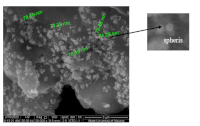
Green synthesis provides a sustainable approach for nanoparticle production by minimizing toxic reagents and environmental impact. Given the increasing demand for eco-friendly nanomaterials with biomedical and environmental relevance, this study aimed to synthesize and characterize silver nanoparticles (AgNPs) using aqueous extracts of Coffea canephora L. leaves, which are rich in antioxidant compounds serving as natural reducing agents. The biosynthesized AgNPs exhibited a localized surface plasmon resonance (LSPR) peak at 438 nm, while SEM analysis revealed irregular morphologies with an average particle size of ~70 nm. Dynamic light scattering confirmed a Z-average of 70.16 nm and a low polydispersity index (0.244), indicating high dispersion stability. Compared to the crude leaf extract, the AgNPs showed significantly enhanced antioxidant potential, with stronger DPPH radical scavenging activity (IC₅₀ = 51.94 ± 0.59 mg/L vs. 85.29 ± 3.67 mg/L). Moreover, the AgNPs demonstrated excellent sensing capability toward H₂O₂, achieving detection limits as low as 0.0068 mM and 0.0575 mM. These results suggest that Coffea canephora L. mediated AgNPs not only provide an eco-friendly route for nanoparticle synthesis but also hold strong potential for biomedical, biosensing, and active food packaging applications.
Downloads
Article Details
Section

This work is licensed under a Creative Commons Attribution-NonCommercial-NoDerivatives 4.0 International License.
How to Cite
References
1. Dolai J, Mandal K, Jana NR. Nanoparticle Size Effects in Biomedical Applications. ACS Appl. Nano Mater. 2021; 4(7): 6471–6496. Doi: 10.1021/acsanm.1c00987.
2.Ulusoy U. A Review of Particle Shape Effects on Material Properties for Various Engineering Applications: From Macro to Nanoscale. Minerals. 2023: 91–172. Doi:10.3390/min13010091
3.Aldwayyan AS, Al-Jekhedab FM, Al-Noaimi M, Hammouti B, Hadda TB, et al. Synthesis and Characterization of CdO Nanoparticles Starting from Organometalic Dmphen-CdI2 complex, Int. J. Electrochem.2013;8(8):10506-10514. Doi:10.1016/S1452-3981(23)13126-9.
4. Raza MA, Kanwal Z, Rauf A, Sabri AN, Riaz S, Naseem S. Size- and shape-dependent antibacterial studies of silver nanoparticles synthesized by wet chemical routes. Nanomaterials. 2016; 6(74): 1-15. Doi:10.3390/nano6040074.
5.Yetisgin AA, Cetinel S, Zuvin M, Kosar A, Kutlu O. Therapeutic Nanoparticles and Their Targeted Delivery Applications. Molecules. 2020; 25(9):2193. Doi: 10.3390/molecules25092193
6.Saidi N, Azzaoui K, Ramdani M, Mejdoubi E, Jaradat N, Jodeh S, Hammouti B, Sabbahi R, Lamhamdi A. A. Design of Nanohydroxyapatite/Pectin Composite from Opuntia Ficus-Indica Cladodes for the Management of Microbial Infections. Polymers. 2022;14: 4446. Doi: 10.1016/S1452-3981(23)13126-9
7.Al-Thani AN, Jan AG, Abbas M, Geetha M, Sadasivuni KK. Nanoparticles in cancer theragnostic and drug delivery: A comprehensive review. Life Sci. 2024; 352: 122899. Doi: 10.1016/j.lfs.2024.122899
8.Lu W, Senapati D, Wang S, Tovmachenko O, Singh AK, Yu H. Effect of surface coating on the toxicity of silver nanomaterials on human skin keratinocytes, Chem. Phys. Lett. 2010; 487(1-3):92-96. Doi: 10.1016/j.cplett.2010.01.027
9.Shanmuganathan R, Karuppusamy I, Saravanan M, Muthukumar H, Ponnuchamy K, Ramkumar VS. Synthesis of Silver Nanoparticles and their Biomedical Applications - A Comprehensive Review. Curr Pharm Des. 2019;25(24): 2650–60. Doi: 10.2174/1381612825666190708185506
10.Yin IX, Zhang J, Zhao IS, Mei ML, Li Q, Chu CH. The antibacterial mechanism of silver nanoparticles and its application in dentistry. Int J Nanomedicine. 2020; 5: 2555–2562. Doi:10.2147/IJN.S246764
11.Jaswal T, Gupta J. A review on the toxicity of silver nanoparticles on human health, Materials Today: Proceedings. 2023; 81(2): 859-863. Doi:10.1016/j.matpr.2021.04.266
12.Wang L, Wu Y, Xie J, Wu S, Wu Z. Characterization, antioxidant and antimicrobial activities of green synthesized silver nanoparticles from Psidium guajava L. leaf aqueous extracts. Mater Sci Eng C. 2018; 6(April 2017): 1–8. Doi :10.1016/j.msec.2018.01.003
13.Maxiselly Y, Anusornwanit P, Rungkong A, Chiarawipa R, Chanjula P. Morpho-Physiological Traits, Phytochemical Composition, and Antioxidant Activity of Canephora Coffee Leaves at Various Stages. Int. J. Plant Biol. 2022; 13(2): 106-114; Doi: 10.3390/ijpb13020011
14.Wang L, Wu Y, Xie J, Wu S, Wu Z. Characterization, antioxidant and antimicrobial activities of green synthesized silver nanoparticles from Psidium guajava L. leaf aqueous extracts. Mater Sci Eng C. 2018; 6(April 2017): 1–8. Doi :10.1016/j.msec.2018.01.003
15. Priya RS, Geetha D, Ramesh PS. Antioxidant activity of chemically synthesized AgNPs and biosynthesized Pongamia pinnata leaf extract mediated AgNPs – A comparative study. Ecotoxicol Environ Saf. 2016;134: 308–318. Doi: 10.1016/j.ecoenv.2015.07.037.
16.Retnaningtyas Y, Dewi N, Kristiningrum N, Kuswandi B. Antioxidant Activity and H2O2 Sensing Ability of Silver Nanoparticles Synthesized Using Solanum melongena L. Peel Extract. Trop JNat Prod Res.2025;9(6): 2587-2594. Doi: 10.26538/tjnpr/v9i6.34
17.Nichita C, Al- Behadilli FM, Vasile E, Stamatin I. Silver Nanoparticles Synthesis. Bioreduction With Gallic Acid And Extract from Cyperus Rotundus L. Digest J. Nanomater. Biostruct. 2020; 15(2): 419-433
18.Saratale RG, Saratale GD, Cho SK, Ghodake G, Kadam A, Kumar S. Kim DS, Shin HS. Phyto-fabrication of silver nanoparticles by Acacia nilotica leaves: Investigating their antineoplastic, free radical scavenging potential and application in H2O2 sensing. J Taiwan Inst Chem Eng. 2019; 99: 239–49. Doi: 10.1016/j.jtice.2019.03.003
19.Kumar V, Singh DK, Mohan S, Bano D, Gundampati RK, Hasan SH. Green synthesis of silver nanoparticle for the selective and sensitive colorimetric detection of mercury (II) ion. J. Photochem. Photobiol. B. 2017;168: 67–77. Doi: 10.1016/j.jphotobiol.2017.01.022
20.Kumar B, Ají A, (2021). Chilli-Assisted Phytosynthesis of Silver Nanoparticles and Their H2O2 Sensing Ability. Research square. 2021: 1–14. Doi: 10.21203/rs.3.rs-479226/v1
21.Teodoro KBR, Migliorini FL, Christinelli WA, Correa DS. Detection of hydrogen peroxide (H2O2) using a colorimetric sensor based on cellulose nanowhiskers and silver nanoparticles. Carbohydr Polym. 2019; 212 :235–41. Doi: 10.1016/j.carbpol.2019.02.053
22.Srikhao N, Kasemsiri P, Lorwanishpaisarn N, Okhawilai M. Green synthesis of silver nanoparticles using Sugarcane leaves extract for colorimetric detection of ammonia and hydrogen peroxide. Res Chem Intermed. 2021; 47(3): 1269–83. Doi : 10.1007/s11164-020-04354-x
23.Fafal T., Tastan P, Tuzun BS, Ozyazici M, Kivcak B. Synthesis, characterization and studies on antioxidant activity of silver nanoparticles using Asphodelus aestivus Brot. aerial part extract. 2017; 112:346-353. Doi : 10.1016/j.sajb.2017.06.019
24.Kartini K, Alviani A, Anjarwati D, Fanany AF, Sukweenadhi J, Avanti C. Process Optimization for Green Synthesis of Silver Nanoparticles Using Indonesian Medicinal Plant Extracts. Processes. 2020; 8: 998-1008. Doi: 10.3390/pr8080998.
25.Aadil KR, Barapatre A, Meena AS, Jha H. Hydrogen peroxide sensing and cytotoxicity activity of Acacia lignin stabilized silver nanoparticles. Int J Biol Macromol. 2015; 82: 39–47. Doi: 10.1016/j.ijbiomac.2015.09.072
26.Chelly M, Chelly s, Zribi R, Bouaziz-Ketat H, Gdoura R, Lavanya N, Veerapandi G, Sekar C, Neri G. Synthesis of Silver and Gold Nanoparticles from Rumex roseus Plant Extract and Their Application in Electrochemical Sensors. Nanomaterials. 2021; 11(3): 739-756. Doi: 10.3390/nano11030739
27.Farrokhnia M, Karimi S, Momeni S, Khalililaghab S. Colorimetric sensor assay for detection of hydrogen peroxide using green synthesis of silver chloride nanoparticles: Experimental and theoretical evidence. Sens. Actuators B Chem. 2017; 246: 979–987. Doi: 10.1016/j.snb.2017.02.066.