


The Potency of Green Tea Powder in Enhancing the Antioxidant Activity and Sensory Properties of Pluchea-Butterfly Pea Flower Herbal Tea
Article Sidebar
Views | PDF/EPUB Downloads:
89
/ 67
/ 37
Main Article Content
Abstract
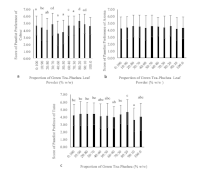
Pluchea herbal tea, derived from pluchea leaf powder infusion, exhibits an unappealing colour and low antioxidant activity. A previous study combining pluchea leaf powder with butterfly pea flower powder in a 40:60% w/w ratio improved sensory preference but failed to significantly enhance bioactive constituents and antioxidant activity. Given the well-documented antioxidant properties of green tea, this study aimed to investigate the effects of incorporating green tea on the antioxidant activity, bioactive constituents, and sensory properties of herbal tea composed of green tea-pluchea leaf and butterfly pea flower powders in a 40:60% w/w ratio. A randomized block design was employed with a single factor: the proportion of green tea powder to pluchea leaf powder (0:100, 10:90, 20:80, 30:70, 40:60, 50:50, 60:40, 70:30, 80:20, 90:10, and 100:0% w/w) in four replicates. Among these formulations, the 80:20% ratio of green tea to pluchea leaf powder demonstrated the most significant improvement in DPPH free radical scavenging activity with value of 981±12 mg GAE/kg, bioactive compounds content, with total phenol content of 37,469±413 mg GAE/kg and total flavonoid content of 3406±29 mg CE/kg. The panelist preference of colour parameter was also improved, but ferric reducing antioxidant power and other sensory properties, such as aroma and taste were not significantly different compared with the control (pluchea leaf powder with butterfly pea flower powder in 40:60% ratio). These results indicate that the formulation of green tea, pluchea leaf, and butterfly pea flower powders at 28:12:60% w/w ratio have strong potential for development as a functional herbal beverage.
Downloads
Article Details
Section

This work is licensed under a Creative Commons Attribution-NonCommercial-NoDerivatives 4.0 International License.
How to Cite
References
1.Widyawati PS, Budianta TDW, Utomo AR, Harianto I. The physiochemical and antioxidant properties of Pluchea indica Less drink in tea bag packaging. Int. J. Food Nutr. Sci. 2016; 5(3):113-120.
2.Widyawati PS, Suseno TIP, Wilianto TL, Yohanita C, Wulandari TA. Effect of lemon (Citrus limon L.) addition to Pluchea indica Less beverage. Carpath. J. Food Sci. Technol. 2020; 12(4):125-139.
3.Widyawati PS, Budianta TDW, Werdani YDW, Halim MO. Antioxidant activity of black tea pluchea leaf drink (Pluchea indica Less-Camelia sinensis). Agritech. 2018; 38(2):200-207. https://doi.org/10.22146/agritech.25699
4.Widyawati PS, Werdani YDW, Setiakusumo C, Kartikasari A. In vitro antioxidant capacities and antidiabetic properties of pluchea leaves and green tea mixtures at various proportions. IJPPS. 2017; 9(8):203-208.
5.Tariq AL, Reyaz AL. Antioxidant activity of Camelia sinensis leaves. Int. J. Curr. Microbiol. Appl. Sci. 2013; 2(5):40-46
6.Habiburrohman D, Sukohar A. Antioxidant and antimicrobial activity of green tea polyphenols. J. Agromed. Unila. 2018; 5 (2):587-591. https://juke.kedokteran.unila.ac.id/index.php/agro/article/view/2116
7.Hasan MdR, Haque MM, Hoque MdA, Sultana S, Rahman MM, Shaikh MdAA, Sarker MdKU. Antioxidant activity study and GC-MS profiling of Camellia sinensis Linn. Heliyon. 2023; 10(1):e23514.
8.Wibowo NK, Rudyanto M, Purwanto DA. Antioxidant activity of green tea and black tea. Camellia. 2022; 1(1): 48-55. https://doi.org/10.30651/cam.v1i2.16722
9.Widyawati PS, Wijaya CH, Hardjosworo PS, Sajuthi D. Volatile compounds of Pluchea indica Less and ocimum basillicum linn essential oil and potency as antioxidant. Hayati J. Biosci. 2013; 20(3):117-126.
10.Ladeska V, Elya B, Hanafi M, Kusmardi. Antioxidants, total phenolic and flavonoid content and toxicity assay of ampelas (Tetracera macrophylla Wall.Ex Hook.F.& Thoms) from Kalimantan-Indonesia. Phcog. J. 2022; 14(5):642-648.
11.Widyawati PS, Wilianto YR. Effect of steeping temperature and storage period on the bioactive plush antioxidant and antidiabetic activities of infusion from powdered Pluchea indica Less. Philipp. J. Sci. 2024; 153(3):1077-1090.
12. Baliyan S, Mukherjee R, Priyadarshini A, Vibhuti A, Gupta A, Pandey RP, Chang CM. Determination of antioxidants by DPPH radical scavenging activity and quantitative phytochemical analysis of Ficus religiosa. Molecules. 2022; 27(4):1326.
13.Okafor CE, Ijoma IK, Igboamalu CA, Ezebalu CE, Eze CF, Osita-Chikeze JC, Uzor CE, Ekwuekwe AL. Secondary metabolites, spectra characterization, and antioxidant correlation analysis of the polar and nonpolar extracts of Bryophyllum pinnatum (Lam) Oken. BioTechnol. 2024; 105(2):121–136.
14.Widyawati PS, Suseno TIP, Widjajaseputra AI, Widyastuti TEW, Moeljadi VW, Tandiono S. The effect of -carrageenan proportion and hot water extract of Pluchea indica Less leaf tea on the quality and sensory properties of stink lily (Amorphophallus muelleri) wet noodles. Molecules. 2022; 27(16):5062.
15.Palafox-Carlos H, Gil-Chavez J, Satelo-Mundo RR, Namiesnik J, Gorinstein S, Gonzalez-Aguilar GA. Antioxidant interactions between major phenolic compounds found in ‘ataulfo’ mango pulp: chlorogenic, gallic, protocatechuic and vanillic acids. Molecules. 2012; 17(11):12657-12664.
16.Lorenzo JM, Eduardo P, Munekata S. Phenolic compounds of green tea health benefits and technological application in food. Asian Pac. J. Trop. Biomed. 2016; 6(8):709-719.
17.Ning Zhao C, Yi Tang G, Yu Cao S, Yu Xu X, You Gan R, Liu Q, Qian Mao Q, Shang A, Bin Li H. Phenolic profiles and antioxidant activities of 30 tea infusions from green, black, oolong, white, yellow, and dark teas. Antioxidants. 2019; 8(7):215
18.Singh R, Chia Yu C, Wei Chen G, Hsueh Chen C, Sinaki NH, Lin J, Koksel F. Butterfly pea flower as a novel ingredient to produce antioxidant-enriched yellow pea-based breakfast cereals. Foods. 2022; 11(21):3447.
19.Shahidi F, Dissanaya CS. Phenolic-protein interactions: insight from in silico analysis- a review. Food Prod. Process Nutr. 2023; 5(2):1-21.
20.Abdel-Aa ASM, Rabalski I, Mats L, Rai FI. Identifications and quantifications of anthocyanin and catechin compounds in purple tea leaves and flakes. Molecules. 2022; 27(19):6676.
21.Hidalgo M, Sanchez-Moreno C, Pascual-Teresa S. Flavonoid-flavonoid interaction and its effect on their antioxidant activity. Food Chem. 2010; 121(3):691-696.
22.Gulcin I, Alwasel SH. DPPH radical scavenging assay. Process. 2023; 11(8):2248.
23.Liang T, Yue W, Li Q. Comparison of the phenolic content and antioxidant activities of Apocynum venetum L. (Luo-Bu-Ma) and two of its alternative species. Int. J. Mol. Sci. 2010; 11(11):4452-4464.
24.Rana ZH, Alam MK, Akhtaruzzaman M. Nutritional composition, total phenolic content, antioxidant and α-amylase inhibitory activities of different fractions of selected wild edible plants. Antioxidants. 2019; 8(203):1-15.
25.Nugraha NS, Listyani TA, Septiarini AD. The antioxidant test and determination of phenolic content in packaged green tea using the FRAP method. SCPJ. 2022; 1(2):59-68.
26.Yang R, Tian J, Liu Y, Zhu L, Sun J, Meng D, Wang Z, Wang C, Zhou Z, Chen L. Interaction mechanism of ferritin protein with chlorogenic acid and iron ion: the structure, iron redox, and polymerization evaluation. Food Chem. 2021; 349:129144.
27.Hynes MJ, O’Coinceanainn M. The kinetics and mechanisms of reactions of iron (III) with caffeic acid, chlorogenic acid, sinapic acid, ferulic acid and naringin. J. Inorg. Biochem. 2004; 98(8):1457-1464.
28.Zhao T, Li C, Wang S, Song X. Green tea (Camellia sinensis): a review of its phytochemistry, pharmacology, and toxicology. Molecules. 2022; 27(12):3909.
29.Marpaung M. Review of the benefits of butterfly pea flowers (Clitoria ternatea L.) for human health. JFFN. 2020; 1(2):47-69. https://doi.org/10.33555/jffn.v1i2.30
30.Firman, Yusuf M, Utami M, Rahmawati, Alam S. Sensory evaluation and characterization of physicochemical properties of polyphenol-rich instant drinks from selected cocoa beans. Proc. Res. Results Conf. (SNP2M). 2018; 143-148p. https://repository.poliupg.ac.id/id/eprint/2211/1/Ejektor_SNP2m_2018.pdf
31.Wang J, Li X, Wu Y, Qu F, Liu L, Wang B, Wang P, Zhang X. HS−SPME/GC−MS reveals the season effects on volatile compounds of green tea in high−latitude region. Foods. 2022; 11(3016):1-14.
32.Prihandini YA, Maulana AH, Humairah N, Dinor MM, Putri M, Handayani L. The effect of the quality of added butterfly pea flower flour (Clitoria ternatea) on the organoleptic properties of cheese cake as a dessert box. J. Nutr. Culinary. 2024; 4(1): 17-23. https://doi.org/10.24114/jnc.v4i1.51171